Announcing Q3, 2026 Btrust Developer Grant Recipients
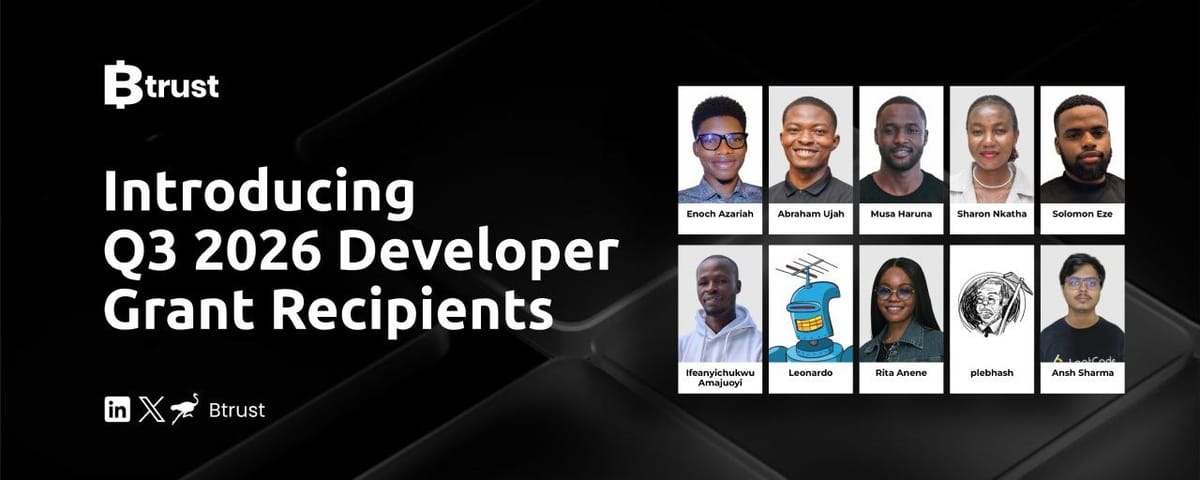
Global Majority, 23rd September, 2026 — We’re excited to announce the Q3 2026 Btrust developer grant recipients. This quarter, ten Bitcoin open-source developers are receiving support, including five starter grant recipients and five long-term open-source cohort members.
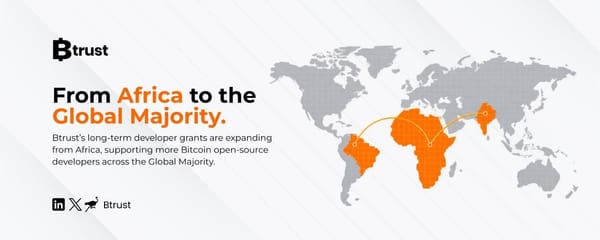
This quarter also marks an important first: Btrust developer grants are going directly to developers outside Africa. We recently expanded our long-term developer grants across the Global Majority, welcoming Leonardo and plebhash in Brazil, and Ansh Sharma in India. Recently featured in our blog, these three recipients represent an important step in our mission to decentralize Bitcoin open-source development.
Alongside this expansion, we continue to support developers across Africa. This cohort includes contributors based in Nigeria and Kenya, with work spanning Bitcoin Core, mining infrastructure, Lightning tools, wallet libraries, and privacy-preserving payments.
A defining theme of this cohort is the infrastructure behind everyday bitcoin use. From the libraries that wallet developers build on to the protocols that connect miners, much of this work happens behind the scenes. Improving these foundations helps make Bitcoin applications more reliable and gives developers better tools to build with.
Mining is another important focus this quarter. Several recipients are contributing to different parts of the mining stack, including Bitcoin Core’s mining interface, Braidpool, and Stratum V2. Supporting work across these projects helps strengthen the open-source infrastructure that miners and mining software developers depend on.
Starter Grants
The Btrust starter grant supports software engineers who are ready to contribute full-time to open-source Bitcoin development. It gives recipients the time, mentorship, and financial support they need to explore a focused area of Bitcoin open source, make meaningful contributions, and grow into long-term contributors.
Starter Grant Recipients
Enoch Azariah
Enoch is a developer based in Adamawa, Nigeria. His grant-funded work will focus on Bitcoin Core’s inter-process communication (IPC) mining interface, libmultiprocess, and the Stratum V2 template provider.
These tools help different parts of mining software communicate. An IPC interface allows separate software processes to exchange information, while a template provider supplies the candidate block information used by mining infrastructure. This makes the connection between Bitcoin Core and external mining software an important part of the mining stack.
With the starter grant, Enoch will focus on strengthening this connection, working on the interfaces and supporting tools that allow these components to operate together. His work will support the integration of Bitcoin Core with Stratum V2 mining infrastructure.
Abraham Ujah
Abraham is a developer based in Kaduna, Nigeria. His journey into Bitcoin open-source development began through BitDevs Kaduna, where connecting with the local community prompted him to explore how he could turn his interest in Bitcoin into a career.
He went on to participate in Chaincode Labs’ Bitcoin and Lightning Protocol Development Seminars and the Kaduna Lightning Developer Bootcamp by Africa Free Routing, building his understanding of the protocols and gaining practical experience developing Lightning applications. He also enrolled in Bitcoin Core Principles by Librería de Satoshi, deepening his understanding of Bitcoin’s technical foundations and philosophical underpinnings.
Abraham completed the 2026 BOSS Challenge and was featured by Btrust Builders as one of eleven African participants whose journeys stood out across the challenge.
These experiences helped him transition into contributing to rust-bitcoin and rust-lightning, two open-source libraries that give developers reusable building blocks for Bitcoin and Lightning applications.
With the starter grant, Abraham will focus on testing, protocol libraries, and developer tooling across these projects. His work will help strengthen the shared infrastructure that developers depend on to build reliable Bitcoin and Lightning software.
Musa Haruna
Musa is a developer based in Borno State, Nigeria. He completed the 2025 BOSS program and began contributing to Bitcoin Core by reviewing tests and familiarizing himself with the codebase. He later enrolled in the 2025 Btrust Builders Open-Source Bootcamp, deepening his understanding of the Bitcoin ecosystem and Bitcoin Core internals.
His work now centers on Bitcoin Core review, fee estimation research, and kernel and application programming interface (API) development. Fee estimation helps wallets assess the transaction fee likely to be needed for timely confirmation, while kernel and API work helps make Bitcoin Core’s underlying functionality available to other software.
With the starter grant, Musa will focus on reviewing Bitcoin Core changes and advancing his research and development in these areas. His work combines technical exploration with the careful, ongoing review that Bitcoin Core depends on.
Beyond his technical contributions, Musa serves as a chaperone for the Btrust Builders Mastering Bitcoin pathway. He moderates weekly discussions with developers, helping participants work through course material, clarify complex concepts, and deepen their understanding of Bitcoin.
Sharon Nkatha
Nkatha is a developer based in Nairobi, Kenya, and an alumna of Dada Devs and Btrust Builders. She recently completed the 2026 BOSS Challenge, where she made her first major contribution to Bitcoin open-source software.
Her work focuses on Braidpool’s mining infrastructure, particularly Stratum V1 reliability, protocol completeness, and scalability. Braidpool is a project working on decentralized Bitcoin mining pools. Stratum V1 is a widely used protocol through which mining devices receive work and submit results, making reliable support important for connecting existing mining equipment to pool infrastructure.
With the starter grant, Nkatha will focus on strengthening Braidpool’s Stratum V1 support, addressing gaps in its protocol implementation, and improving its ability to handle growing demand. Her work will help develop the connections between mining hardware and decentralized pool software.
Beyond coding, Nkatha is an active member of BitDevs Nairobi, where she helps lead topic discussions during meetups, supporting learning and knowledge-sharing within the local Bitcoin developer community.
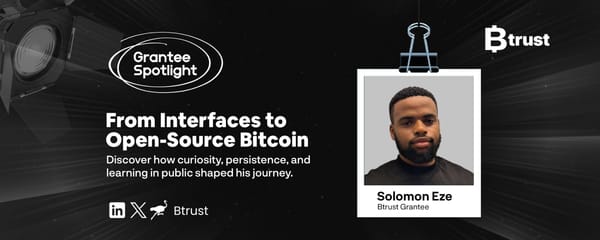
Solomon Eze
Solomon is a developer based in Lagos, Nigeria. His work focuses on Cashu wallet infrastructure, primarily Coco, with downstream integration into eNuts.
Cashu is an open-source ecash protocol that uses cryptography to support private payments. Cashu wallets hold tokens issued by a mint rather than bitcoin directly on the Bitcoin blockchain. This introduces a different trust model: users depend on the mint to redeem those tokens.
With the starter grant, Solomon will focus on the infrastructure that supports these wallets. His work on Coco and its integration into eNuts will connect shared wallet components with a user-facing application, helping translate infrastructure improvements into practical wallet functionality.
Beyond code, Solomon is a Btrust Builders faculty member, helping share knowledge and support developers as they build their understanding of Bitcoin and open-source development.
Long-Term Grants
Btrust’s long-term grants give developers the continuity to deepen their contributions, take on sustained maintenance work, and address challenges that extend beyond a single development cycle.
Our recent expansion of these grants across the Global Majority builds on that commitment. This quarter’s long-term recipients, based in Nigeria, India, and Brazil, are working across Lightning infrastructure, decentralized mining, mining protocols, and wallet development tools.
Long-Term Grant Recipients
Rita Anene
Rita is a developer based in Lagos, Nigeria. Her work focuses on LDK Node, a ready-to-use Lightning node library that helps developers add Lightning functionality to their applications.
With the long-term grant, Rita will focus on making LDK Node more reliable and easier to integrate, helping developers build applications that support both on-chain and Lightning payments.
Beyond code, Rita is an active member of BitDevs Lagos and serves as a Btrust Builders pathway chaperone, supporting developers as they work through learning material and deepen their understanding of Bitcoin.
Ifeanyichukwu Amajuoyi
Ifeanyichukwu is a developer based in Lagos, Nigeria. His work focuses on LDK Server, with an emphasis on monitoring, Postgres support, unified logging, and API improvements.
The LDK Server provides a server interface for Lightning functionality, helping applications interact with a Lightning node through an API. Reliable monitoring and logging help developers understand how their systems are behaving and investigate problems, while database support helps manage application data.
With continued support from Btrust, Ifeanyichukwu will strengthen these operational foundations, making ldk-server easier to integrate, maintain, and run reliably.
Ansh Sharma
Ansh is a developer based in India. He is one of the first developers Btrust has directly funded outside Africa, joining the long-term cohort through our recent expansion across the Global Majority.
His work focuses on Braidpool, a project developing decentralized Bitcoin mining pool infrastructure. Decentralized pooling aims to let miners coordinate their work without relying on a single central pool operator.
With the long-term grant, Ansh will focus on Braidpool’s performance, scalability, and network resilience. This includes the technical challenges involved in keeping a distributed mining system responsive and reliable as participation grows and network conditions change.
His work complements the broader focus on mining infrastructure in this cohort, supporting the development of alternatives to centralized pool coordination.
plebhash
plebhash is a developer based in Brazil and one of the first recipients of direct Btrust developer funding outside Africa.
His work focuses on Stratum V2, a protocol for communication between mining devices, proxies, and pools. Stratum V2 introduces improvements to mining communication, including encrypted connections and support for miners to select transaction sets through its job declaration protocol.
With the long-term grant, plebhash will focus on maintaining the Stratum V2 specification and reference implementation, improving interoperability, and strengthening production reliability.
This work helps ensure that different implementations can communicate consistently and that developers and operators have dependable open-source software to build on.
Leonardo
Leonardo is a developer based in Brazil. Alongside plebhash and Ansh, he is among the first developers Btrust has directly funded outside Africa through the recent expansion of our long-term developer grants.
His work focuses on the Bitcoin Development Kit (BDK), a collection of libraries and tools that helps developers build Bitcoin wallets.
A key part of that work is maintaining BDK’s blockchain data-source clients. These components allow wallet software to obtain the blockchain information it needs to track transactions and balances. Reliable connections to those data sources are essential to a wallet’s ability to present accurate information to its users.
With the long-term grant, Leonardo will continue contributing to BDK maintenance, particularly these data-source clients, alongside developer mentorship. His work combines sustaining widely used wallet infrastructure with helping other developers build the knowledge to contribute.
Supporting Long-Term Bitcoin Contribution
This cohort reflects both the breadth of work needed to sustain Bitcoin open source and the importance of supporting the people doing it.
Some recipients are beginning a period of focused, full-time contribution. Others are taking on longer-term maintenance and development responsibilities. Across both groups, the goal is the same: to give developers the support they need to do careful, useful work and grow as contributors.
That support also extends to the events and programs that help developers find their way into Bitcoin open source. By supporting learning pathways, bootcamps, and opportunities for hands-on contribution, we help create spaces where developers can build their skills and where we can discover emerging talent.
BitDevs communities are another common thread across this cohort’s journeys. These local spaces give developers opportunities to ask questions, deepen their technical understanding, and connect with other contributors. Several recipients now help sustain those same communities by leading discussions, sharing knowledge, and supporting others taking their first steps.
The expansion of our long-term grants beyond Africa is another step toward a more geographically distributed Bitcoin developer ecosystem. Supporting contributors in India and Brazil, alongside our continued work in Africa, brings more perspectives and experience into the projects that underpin Bitcoin.
We’re excited to support these ten developers and look forward to sharing more about their work.
Applications for Btrust Developer Grants
Btrust developer grant applications are open all year round, with new recipients announced quarterly.
If you are already contributing to Bitcoin open-source software, or you are ready to begin contributing full-time, we encourage you to learn more and apply.
You can learn more about Btrust developer grants and explore other Btrust grant opportunities on our website.
About Btrust
Btrust is a non-profit organization with a mission to decentralize the development of Bitcoin open-source software. We focus on supporting developer talent from the Global Majority and strengthening the free and open-source Bitcoin ecosystem.
Through grants, education, mentorship, and community support, Btrust helps developers contribute to the tools, infrastructure, and applications that make bitcoin more resilient, accessible, and decentralized.