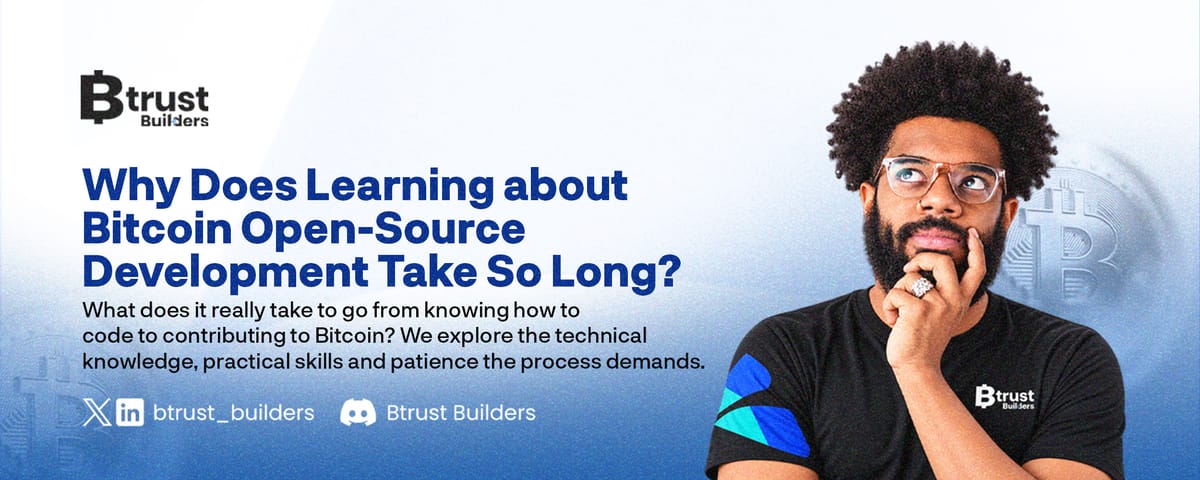
Why Does Learning about Bitcoin Open-Source Development Take So Long?
A developer can spend years writing software and still feel like a beginner when they start working on Bitcoin.
They may already know Git, build applications and work comfortably with Go, Rust or C++. But contributing to Bitcoin software introduces another set of questions. How are transactions structured? How do nodes validate them? How do scripts and signatures determine whether funds can be spent? And how does a particular implementation enforce the protocol’s rules?
Answering these questions involves more than learning a framework or finding a way around a new codebase. Developers must understand the system, see how its behaviour is expressed in software and learn to make changes alongside contributors around the world.
In this article, we draw on the experiences of participants in the 2026 BOSS Challenge to explore what this learning journey looks like in practice. Their reflections highlight recurring challenges: translating theory into working code, navigating unfamiliar projects, interpreting technical specifications and finding time to keep learning.
Their experiences help explain why the process takes time, and why developers do not need to master everything before they begin.
Understanding Bitcoin Beyond the Basics
Using Bitcoin, understanding its principles and contributing to its software require different levels of knowledge.
Depending on the project, developers may need to understand transactions, inputs and outputs, scripts, signatures, blocks or consensus rules. More importantly, they need to understand how these components interact.
Working on coin selection, for example, requires an understanding of unspent transaction outputs, or UTXOs. Building transaction-signing functionality means understanding the relevant scripts and signature requirements. Lightning development draws on the Bitcoin transactions and mechanisms used to establish, update and settle payment channels.
The knowledge required depends on the task. A developer does not need to understand every part of Bitcoin to contribute to a wallet, but they do need enough context to reason about the behaviour they are changing.
Some BOSS Challenge participants had read Mastering Bitcoin, worked through Saving Satoshi or attended technical developer seminars before joining. These provided useful foundations. Practical work still required them to revisit concepts, investigate unfamiliar areas and deepen their understanding.
Recognizing a concept is a starting point. Working with it in software requires knowing how it behaves under specific conditions, and what can go wrong.
Moving from Theory to Working Code
Understanding what a feature does is not the same as knowing how to implement it.
Consider partially signed bitcoin transactions, or PSBTs. A developer may understand that the format allows wallets and signing devices to exchange a transaction alongside information needed to sign it. Implementing support requires more precise work: interpreting the specification, handling the relevant fields and versions, and testing how the software responds to valid and invalid data.
The same gap appears elsewhere. Understanding multisignature transactions does not automatically prepare someone to construct one correctly. Knowing the purpose of replace-by-fee does not mean knowing how to implement the relevant wallet behaviour.
Implementation makes gaps in understanding visible. A broad explanation may be enough to follow a discussion, but code requires decisions about exact formats, conditions and failure cases.
Several BOSS Challenge participants described this transition. One had studied Bitcoin through books and learning programs but still found it challenging to turn Bitcoin primitives into working code. Another drew on experience implementing specifications in a different open-source project when working with Bitcoin Improvement Proposals, or BIPs, and Lightning’s BOLT specifications.
That experience was useful because specifications require close reading. Developers need to distinguish requirements from examples, understand which provisions apply to their task and translate them into behaviour they can test.
The process often sends them back and forth between the specification, the implementation and their tests. That is part of learning how the feature actually works.
Finding Your Way Around an Existing Project
Even when a developer understands a feature, they still need to understand the project they want to change.
Established projects have their own architecture, conventions, dependencies and testing practices. A seemingly small change may touch several components. An issue may describe a problem without explaining the history behind it or why an earlier solution was rejected.
Before writing a fix, a contributor may need to trace a function through the codebase, inspect existing tests, read previous pull requests and ask maintainers for context. They also need to set up a development environment and learn how to build and test their changes.
One BOSS Challenge participant described this investigation as a major part of her learning. Her previous open-source experience helped her read issues, communicate with maintainers and identify possible fixes, but each project still brought unfamiliar technical demands.
Testing adds another layer. Code can compile and still behave incorrectly. A failed test might reveal a mistake in the implementation, a misunderstanding of the requirements or a problem with the test itself. Working out which takes practice.
One participant described a repeated cycle: write a solution, push it to GitHub, inspect the automated check logs, debug and try again. Another found it useful to interact with Bitcoin Core through bitcoin-cli, making operations more explicit than they had been through higher-level tools.
These routines gradually build familiarity. Over time, developers become better at locating relevant code, recognising useful evidence and deciding what to investigate next.
Learning to Contribute with Other People
Open-source development also involves learning how to work with others.
A contribution needs to be understandable to the people reviewing it. Developers must explain the problem they are addressing, describe their approach and provide evidence that their changes behave as intended. They may need to respond to questions, revise an implementation or reconsider whether their original approach fits the project.
For newcomers, this can be unfamiliar even when they have professional software experience. The people involved may work across different time zones, contribute on different schedules and communicate primarily through issues, pull requests and technical discussions.
Progress therefore depends partly on learning to ask useful questions and share enough context for someone else to help. Explaining what you expected, what happened and what you have already tried makes a technical conversation easier to follow.
Review is another source of learning. A question from a maintainer can expose an assumption the contributor had not examined. A request for an additional test can reveal an overlooked failure case. Reading reviews of other people’s work can also help developers understand a project’s expectations before submitting their own changes.
This takes time, but it is part of becoming a contributor, not an administrative step separate from the technical work.
Making Time for Sustained Learning
The learning process does not happen in isolation from the rest of a developer’s life.
BOSS Challenge participants described having to make time for unfamiliar material and demanding technical tasks. For developers balancing employment, study or other responsibilities, finding that time can be difficult.
Some tasks also resist neat scheduling. A developer might set aside an evening to implement a feature, only to spend it resolving an environment issue or investigating a concept they thought they already understood. The visible result may be small, even when the work has been useful.
This can make progress difficult to judge. Completing a course or submitting a pull request provides a clear milestone. Becoming better at reading a specification, tracing a bug or asking a precise question is less visible, but just as important.
Sustained learning requires room for both. Structured programs can provide direction and deadlines, while peers, mentors and local developer communities can help people work through difficulties and maintain momentum.
The aim is not to eliminate every obstacle. It is to make it easier for developers to continue when the next step is unclear.
Different Paths, Different Outcomes
There is no single destination for developers who build these skills. Learning can lead to different kinds of work, and those paths can change over time.
Some of our alumni have become full-time Bitcoin open-source contributors, supported by organizations such as Btrust, the Human Rights Foundation (HRF) and OpenSats. Others have gone on to build their own products or carry the knowledge forward through teaching, mentoring and supporting other developers.
These outcomes are not steps on a fixed ladder. A developer might contribute to an existing project, explore a product idea and later return to open-source work with a different perspective. Someone else might find that helping others understand the technology becomes an important part of their contribution.
Nor is there a point at which learning is complete. New responsibilities, unfamiliar code and difficult problems continue to create opportunities to deepen understanding. The journey is not linear, and progress does not have to look the same for everyone.
Building Understanding Through Practice
Learning Bitcoin open-source development takes time because it brings several kinds of learning together. Developers are building protocol knowledge, interpreting specifications, navigating software and learning to collaborate, all while applying those skills to real problems.
The experiences of the 2026 BOSS Challenge participants show how these skills develop through practice: reading, implementing, testing, asking questions and revisiting earlier assumptions.
The aim is not to understand everything before beginning or to follow one prescribed career path. It is to build enough understanding to take the next step, contribute thoughtfully and keep learning from the work.