Announcing Q4 2026 Btrust Developer Grant Recipients
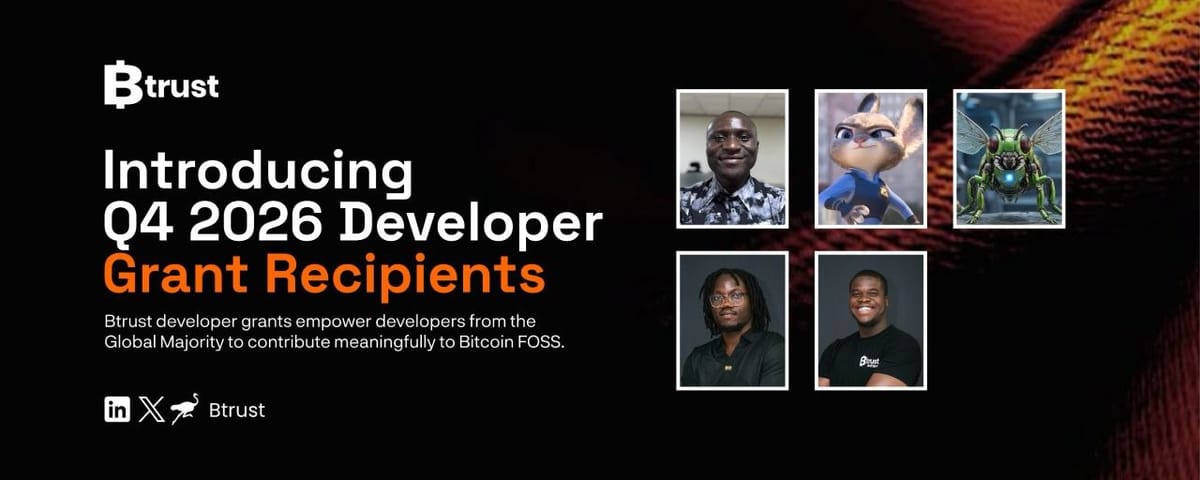
Global Majority, November 24, 2026 — We’re excited to announce the Q4 2026 Btrust developer grant recipients. This quarter, five Bitcoin open-source developers are receiving support: three starter grant recipients and two long-term open-source cohort members.
The recipients are based in Nigeria, Uganda, Malawi, and Kenya, with work spanning Bitcoin Core, Lightning signing infrastructure, Ark developer tools, and privacy-preserving Cashu payments. Together, their contributions reflect the range of open-source work needed to make Bitcoin software more reliable, accessible, and useful.
A defining theme of this cohort is strengthening the software behind everyday bitcoin use. That includes testing how Bitcoin Core behaves under unexpected conditions, helping Lightning node operators monitor their signing infrastructure, and building libraries that make it easier to develop off-chain payment applications.
Starter Grants
The Btrust starter grant supports software engineers who are ready to contribute full-time to open-source Bitcoin development. It gives recipients the time, mentorship, and financial support they need to explore a focused area of Bitcoin open source, make meaningful contributions, and grow into long-term contributors.
Starter Grant Recipients
Gideon Bature
Gideon is a developer based in Nigeria, with a background in Rust, systems programming, and backend development. His journey into Bitcoin open source began through the 2025 BOSS program, after which he contributed to projects including corepc, Rust-Payjoin, BDK Wallet, and the Ark implementation bark.
His grant-funded work will focus on the Validating Lightning Signer (VLS), a project that separates transaction signing from the operation of a Lightning node. Before signing, VLS checks that a proposed transaction follows its security policies. This separation is designed to help protect funds even if the node software is compromised.
Gideon has already contributed improvements to VLS memory usage and protocol error handling, alongside work on fuzz testing and operational policy tools. Fuzz testing exercises software with many varied and unexpected inputs to uncover bugs that ordinary tests may miss.
With the starter grant, he will expand testing across channel management, payment flows, and other critical signer functions. He also plans to develop monitoring metrics, structured event reporting, an administrative interface, and notifications for node operators, in coordination with VLS maintainers. Together, these improvements aim to make the signer easier to test, monitor, and manage in real-world deployments.
Beyond his code contributions, Gideon participates in the BitDevs communities in Kaduna and Lagos.
Winterrdog
Winterrdog is a developer based in Kampala, Uganda, with a background in backend engineering, computer security, networking, and systems programming. He participated in the 2025 BOSS program and contributes to Bitcoin Core through code review, testing, issue investigation, and development.
His contributions have included test coverage for Bitcoin Core’s HTTP server, proposed functional tests for Tor integration, and investigations into block storage and reindexing. He has also reviewed and tested improvements to BlueWallet’s Android build reproducibility, helping make releases easier to independently verify.
With the starter grant, Winterrdog will focus primarily on Bitcoin Core, with BlueWallet as a secondary project. His planned work includes expanding tests for Tor and I2P, reviewing wallet and transaction-signing changes, investigating storage issues, and improving testing on operating systems such as FreeBSD and NetBSD.
Tor and I2P provide alternative ways for Bitcoin nodes to connect while helping protect users’ network privacy. Testing these connections, alongside storage and wallet behavior, helps identify failures that may only appear under particular configurations or unexpected conditions.
His work will combine targeted fixes with the ongoing review and testing that Bitcoin Core depends on. He also participates in BitDevs Kampala, where he gives technical talks and shares guidance with developers exploring Bitcoin open-source contributions.
Shubert Munthali
Shubert is a self-taught programmer based in Lilongwe, Malawi. He began programming in 2017 and later contributed to privacy-focused peer-to-peer Android applications. Receiving bitcoin for that open-source work prompted him to learn more about Bitcoin and eventually begin contributing to Ark Labs’ implementation of the Ark protocol.
His contributions span the Arkade compiler and TypeScript SDK, including work on multisignature support, error handling, wallet data persistence, and transaction fee calculation.
With the starter grant, Shubert will focus on the Arkade Kotlin SDK, a multiplatform library for building applications that use Arkade’s off-chain payment infrastructure. An SDK provides reusable tools that allow developers to integrate a protocol without implementing every component themselves.
His initial focus will be Android and JVM desktop applications. He plans to implement the core client functionality needed to send and receive payments, move bitcoin into the protocol, and support users’ ability to exit back on-chain. Unit and integration testing will accompany this work.
He will also build a proof-of-concept Android wallet to demonstrate the SDK in use. The wallet will serve as a developer reference, helping others understand how to build on the library rather than positioning it as a finished consumer product.
Shubert has joined BitDevs Malawi, where he plans to share his experience and contribute to the local developer community.
Long-Term Grants
Btrust’s long-term developer grants provide sustained support for developers with a demonstrated commitment to Bitcoin open-source work. Through the open-source cohort, recipients can deepen their technical focus, take on larger projects, and continue the maintenance, review, and collaboration that healthy open-source software requires.
Long-Term Grant Recipients
Frankline Omondi
Frankline is a software engineer based in Nairobi, Kenya, working primarily in Rust, C++, and Python. He entered Bitcoin development through the 2025 BOSS program and went on to receive a Btrust starter grant, focusing on Bitcoin Core testing and peer review.
During his starter grant, Frankline developed fuzz tests and investigated gaps in Bitcoin Core’s peer-to-peer networking test coverage. His approach combines coverage analysis, which shows which parts of the code tests reach, with mutation testing, which deliberately changes program behavior to check whether tests detect the difference.
With the long-term grant, he will deepen this work across networking, transaction validation, and related areas of Bitcoin Core. His plans include auditing existing tests, building new fuzz-testing harnesses, improving the inputs used in testing, and turning findings into fixes and regression tests. He also intends to explore additional methods, including symbolic execution and formal verification, to investigate selected parts of the code.
Alongside Bitcoin Core, Frankline maintains bip353-rs, a Rust library for resolving DNS-based bitcoin payment instructions with DNSSEC validation. He also leads sessions at BitDevs Nairobi and plans to mentor newer contributors, drawing on his experience moving from the BOSS program into sustained open-source work.
Michael Ariwaodo
Michael is a software developer based in Lagos, Nigeria. Before entering Bitcoin open source through the 2025 BOSS program, he built software for banks and fintech platforms. That experience shaped his interest in financial privacy and led him to Cashu, a protocol for Bitcoin-backed ecash payments that uses blind signatures to protect payment privacy.
During his starter grant, Michael contributed across Cashu’s protocol specifications, developer libraries, mint software, and wallets. His work included implementing Pay-to-Blinded-Key (P2BK) support in Nutshell, Cashu’s Python mint and wallet implementation. P2BK helps prevent the public key used to receive a locked payment from becoming a link between payments and the recipient’s published identity.
He also worked on payment requests, multiparty signing, mint correctness, and cross-implementation testing. Over this period, he gained maintainer access to Nutshell and helped establish weekly developer calls.
With the long-term grant, Michael will focus on bringing these protocol capabilities into the tools and wallets people use. His plans include improving support for conditional payments, developing a shareable receiving-address format, and integrating P2BK sending and receiving into web and mobile wallets.
Another priority is moving duplicated protocol utilities from individual wallets into CashuTS, a shared TypeScript library. Maintaining these functions in one place can reduce inconsistencies and make fixes easier to carry across applications. He also plans to work on payments funded across multiple mints and Cashu-based escrow for peer-to-peer trading.
Alongside development and maintenance, Michael reviews contributions, helps onboard developers, and participates in BitDevs Lagos, where he has led discussions on Cashu and Bitcoin privacy.
Supporting the Foundations of Bitcoin Open Source
This cohort’s work spans different parts of Bitcoin, but shares a common need: time for careful, sustained engineering. Reviewing a networking change, testing a signer’s response to unexpected inputs, or making a payment library easier to use may happen behind the scenes, yet each supports the software that developers and users depend on.
By supporting contributors at both the starter and long-term stages, Btrust helps developers build experience, deepen their involvement in projects, and sustain their contributions over time. We’re excited to support this cohort as they strengthen Bitcoin open-source infrastructure and share their knowledge across their communities.
Applications for Btrust Developer Grants
Applications for Btrust developer grants will open in January 2027. Developers interested in contributing to Bitcoin open-source software can follow our channels for application details and further announcements.
About Btrust
Btrust is a non-profit organization with a mission to decentralize the development of Bitcoin open-source software. We focus on supporting developer talent from the Global Majority and strengthening the free and open-source Bitcoin ecosystem.
Through grants, education, mentorship, and community support, Btrust helps developers contribute to the tools, infrastructure, and applications that make bitcoin more resilient, accessible, and decentralized.