Q1, 2026 Btrust Developer Grant Announcement
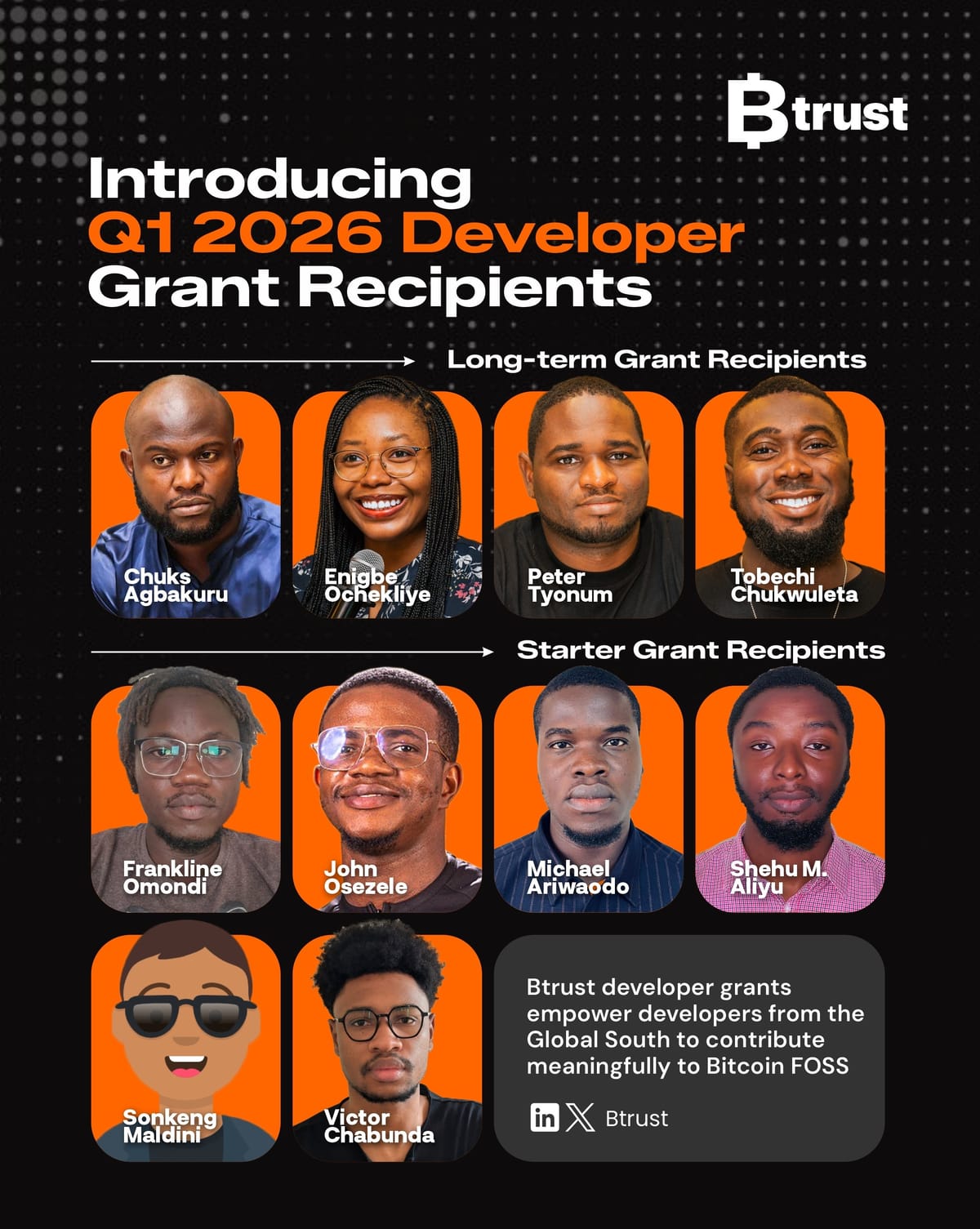
Africa, April 1, 2026 — We're excited to announce our largest Btrust developer grant cohort to date. Ten outstanding Bitcoin open-source developers have been awarded grants, comprising six starter grant recipients and four open-source cohort members, including two renewals and two promotions from starter to long-term grants.
This cohort also marks a couple of firsts: support for Cashu development, and the inclusion of a dedicated research proposal within the open-source cohort. This builds on our existing support across the stack, from core protocol work to wallets, privacy tools, and user-facing applications.
These developers are working across vastly different critical areas of the Bitcoin ecosystem, from Bitcoin Core and Lightning infrastructure to wallet development, privacy protocols, and payment infrastructure. Their work strengthens Bitcoin’s open‑source foundations while expanding the global community of contributors from the Global Majority.
Starter Grants
The Btrust starter grant provides support for software engineers ready to contribute full-time to open-source Bitcoin development. It allows recipients to explore areas of interest, identify a focus for long-term contributions, and engage deeply with the global Bitcoin developer community with relevant support via mentorship and without financial constraints.
Starter Grant Recipients
Michael Ariwaodo
Project: Cashu
Michael is a software developer based in Nigeria with over four years of experience building financial software systems.
After participating in the BOSS program in 2025, Michael began contributing to the Cashu ecosystem, a Chaumian ecash protocol designed to enable fast and privacy‑preserving Bitcoin‑backed payments.
As our first Cashu developer grantee, his recent work includes improvements to Cashu TS and Cashu Nutshell, the reference implementation of a Cashu mint. His contributions have focused on improving mint reliability, removing obsolete legacy APIs, improving wallet compatibility, and aligning implementations with evolving Cashu protocol specifications.
With the starter grant, Michael will continue strengthening the Cashu ecosystem by improving mint safety and operability, completing the removal of deprecated protocol behavior, and expanding compliance with newer Cashu NUT specifications.
He will also introduce protocol compliance tests, improve cross‑implementation compatibility, and research potential interoperability between Cashu and emerging protocols and technologies such as Ark and Minmo.
Frankline Omondi
Projects: Bitcoin Core, bip353-rs
Frankline is a software engineer based in Kenya with experience in systems programming and open‑source infrastructure development.
He completed the BOSS program in 2025 and has since become an active contributor to Bitcoin Core. His work focuses on fuzz testing, networking, and validation logic within consensus‑critical components.
Frankline has contributed to Bitcoin Core’s fuzz testing infrastructure and QA assets, helping improve coverage and detect potential bugs earlier in the development process. He is also the author of bip353‑rs, a Rust implementation of DNS payment instructions with DNSSEC validation.
Through the starter grant, Frankline will dedicate full‑time effort to expanding fuzz testing coverage across key Bitcoin Core subsystems including P2P networking, net processing, and validation logic.
His work will include designing new fuzz harnesses, running long‑duration fuzzing campaigns to uncover edge‑case bugs, and improving documentation and tooling so that more contributors can participate in Bitcoin’s testing infrastructure.
John Osezele
Projects: Bitcoin Dev Kit (BDK), Rust Payjoin
John is a software engineer based in Nigeria with five years of experience building mobile applications across fintech and security platforms.
He is a co‑maintainer of the bdk‑dart project within the Bitcoin Dev Kit ecosystem. The project provides Dart bindings that allow Flutter developers to build Bitcoin wallets powered by BDK’s Rust implementation.
John has already contributed several improvements to the repository and has also contributed to the Rust Payjoin project as part of his journey into Bitcoin open source.
With the starter grant, John will focus on bringing bdk‑dart to production readiness. His work will include improving the stability of the bindings, maintaining compatibility with upstream BDK releases, and strengthening testing and CI infrastructure.
He also plans to build a complete open‑source reference wallet using Flutter and bdk‑dart to demonstrate how developers can build secure non‑custodial Bitcoin wallets using the toolkit.
Victor Chabunda
Projects: rust‑payjoin, UniFFI‑Dart
Chabunda, also known as Chavic, is a developer based in Zambia with nearly a decade of experience building software across multiple platforms.
He is the author of UniFFI‑Dart and a contributor to the rust‑payjoin project, where his work focuses on improving developer experience through cross‑language bindings and tooling.
Victor has played an important role in making Rust‑based Bitcoin libraries accessible to developers working in other programming languages by building robust Foreign Function Interface tooling and SDK integrations.
Through the starter grant, Chavic will focus on building first‑class .NET and C++ bindings for rust‑payjoin, improving documentation and developer tooling, and continuing development on UniFFI‑Dart.
He will also begin work on a transaction fingerprinting analysis tool that helps wallet developers detect privacy leaks in transaction construction and improve overall wallet privacy practices.
Shehu Muhammad Aliyu
Projects: Payjoin Dev Kit (PDK), Bitcoin Dev Kit (BDK)
Shehu is a software engineer based in Nigeria. He holds a degree in Computer Engineering from Ahmadu Bello University and graduated from the 2025 Btrust Builders Rust for Bitcoiners pathway.
Shehu has been actively contributing to the Payjoin Dev Kit (PDK), a project focused on improving bitcoin transaction privacy through collaborative transaction construction. His work has focused on strengthening persistence, improving code maintainability, and addressing protocol‑level security issues.
His contributions include migrating the Payjoin CLI database from Sled to SQLite for better reliability, fixing a potential session replay vulnerability, and improving time‑handling accuracy to align with BIP‑77 specifications. He has also contributed documentation improvements and developer tooling updates that make the project easier for wallet developers to adopt.
With the starter grant, Shehu will work full‑time on expanding Payjoin adoption across Bitcoin tooling. His work will focus on integrating PDK into the Bitcoin Dev Kit CLI, implementing ASMAP‑based relay and directory selection for improved network privacy, and improving reliability through better fallback mechanisms and testing infrastructure.
Sonkeng Maldini
Project: Bitcoin Dev Kit (BDK), Bitcoin Core
Sonkeng is a software engineer based in Cameroon with more than eight years of experience building complex software systems.
His early exposure to Bitcoin development began while working with custom forks of Bitcoin written in C++. Since then, he has worked on distributed trading systems and open‑source infrastructure projects while steadily contributing to Bitcoin‑related development.
Sonkeng has contributed to several projects including the Bitcoin Development Kit, Rust‑Bitcoin, and the Bisq MuSig protocol. He has implemented multisignature wallet features for MuSig and actively participates in code reviews across multiple repositories.
Through the starter grant, Sonkeng will focus on improving developer experience and contributing to new releases within the Bitcoin Development Kit ecosystem. His work will include maintaining fuzz testing infrastructure, contributing to upcoming BDK features such as DNS payment instructions (BIP‑353), supporting silent payments work, and participating in Bitcoin Core Review Club sessions.
He’s also the lead organizer of BitDevs Yaoundé meetups to help grow Bitcoin developer communities in Cameroon.
Long-Term Grants
The Btrust Open-Source Cohort offers long-term support to established Bitcoin open-source contributors, promoting a collaborative environment for sustained development.
Members receive funding paid monthly in bitcoin, mentorship, and peer support to deepen their work on critical Bitcoin open-source projects.
The cohort model aims to build a resilient, inclusive developer ecosystem, enabling contributors from the Global Majority to make meaningful, lasting impacts on Bitcoin's open-source ecosystem.
Long Term Grant Recipients
Chuks Agbakuru
Project: Lightning Dev Kit (LDK)
Chuks is a software engineer based in Nigeria and a former Btrust starter grant recipient who has become a core contributor to the Lightning Dev Kit ecosystem.
Over the past year he has worked extensively on LDK‑Node, contributing features such as support for human‑readable names through BIP‑353 and improvements to infrastructure stability and code reviews.
With this long‑term grant, Chuks will focus on researching and implementing splice batching for the Lightning Network. This work explores how multiple channel splice operations can be coordinated into a single on‑chain transaction, reducing fees and improving scalability for Lightning service providers.
His work will involve specification research, Rust implementation in rust‑lightning, and integration into LDK‑Node APIs.
Peter Tyonum
Project: Bitcoin Dev Kit (BDK)
Peter is a software engineer and maintainer within the Bitcoin Dev Kit ecosystem. Over the past year as a starter grant recipient, he has contributed extensively to bdk‑cli and related wallet infrastructure libraries.
His contributions include implementing hardware wallet support, persistent wallet configuration, compact block filter support, and upgrades to align with the latest BDK wallet APIs.
During the long‑term grant period, Peter will focus on developing a production‑ready Bitcoin Core RPC client library for BDK. This library will serve as a unified interface for interacting with Bitcoin Core across multiple BDK components.
He will also continue maintaining and expanding bdk‑cli, including adding multipath descriptor support and improving testing and reliability across versions.
Enigbe Ochekliye
Project: Lightning Dev Kit (LDK)
Enigbe is a Lightning developer based in Nigeria whose work focuses on Lightning Network infrastructure and research. She holds a Master's in Energy from the University of Auckland, where she completed graduate-level coursework in multivariable control systems, and a Bachelor's in Mechanical Engineering from Ahmadu Bello University.
Over the past year she has contributed to the LDK ecosystem through code development, reviews, and technical research. Her work includes improvements to logging infrastructure, chain synchronization features, and infrastructure reliability across LDK components.
Under the renewed long‑term grant, Enigbe will pursue research into distributed control systems for Lightning Network liquidity management. Her work models Lightning as a multi‑agent dynamical system and explores how decentralized controllers can coordinate liquidity distribution across the network.
The project will combine theoretical research with practical implementation inside ldk‑node and simulation environments, contributing both academic insights and open‑source engineering improvements.
Enigbe is the first member of the Open Source Cohort to focus on research, expanding the scope of contribution within the program and highlighting the growing importance of research-driven work in the ecosystem.
Chukwuleta Tobechi
Project: BTCPay Server
Tobechi is an experienced software engineer, active BTCPay Server contributor, and the lead organizer of BitDevs Lagos.
During his previous grant period, he developed several major plugins including the Shopify Plugin V2, the Satoshi Tickets event plugin, and the Mavapay Naira Checkout integration. His work has expanded BTCPay Server’s usability for merchants and businesses around the world.
Through this renewed long‑term grant, Tobechi will continue expanding BTCPay Server integrations across e‑commerce platforms and accounting systems while strengthening the plugin ecosystem.
He also plans to develop additional integrations that support African payment rails and local currencies, helping businesses across the continent accept Bitcoin payments more easily.
Btrust Builders Alumni
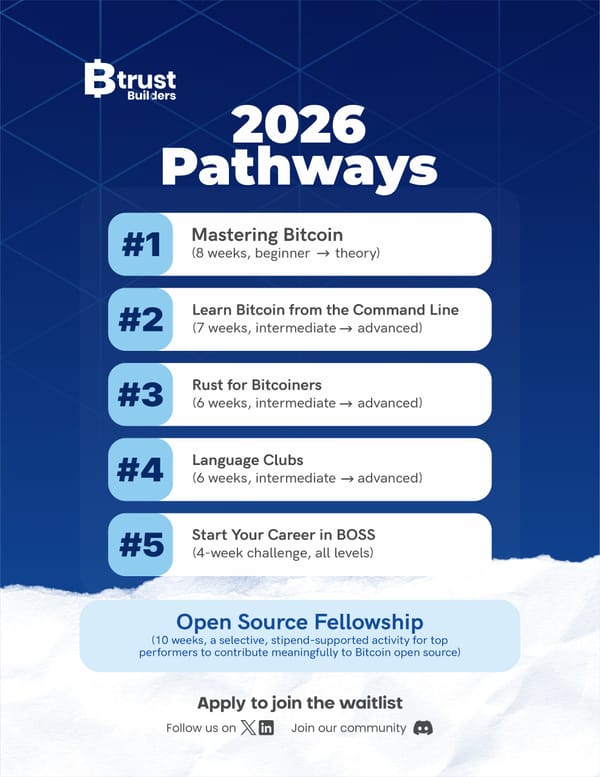
Most of the recipients above are alumni of the Btrust Builders program.
The structured learning tracks they completed provided a strong foundation in Bitcoin fundamentals, hands‑on open‑source experience, and sustained mentorship from seasoned contributors.
Their progression from Builders graduates to funded grantees reflects the program’s mission to cultivate high‑potential developers across the Global Majority and prepare them for long‑term, sustainable careers in Bitcoin open source. Each grantee’s journey underscores what focused guidance, community collaboration, and opportunity can achieve when paired with dedication and talent.
Learn more and apply to join the next cohort of the Btrust Builders pathways here.
Applications for Btrust Developer Grants
Btrust developer grant applications are open year-round, with new recipients announced quarterly. If you’re a developer passionate about contributing to Bitcoin open-source development, we encourage you to apply.
Learn more about our grant programs and apply through our website.
Stay updated on our initiatives and future opportunities by following us on X, Nostr, Instagram and LinkedIn.
About Us
Btrust is a non-profit organization with a dedicated mission to decentralize the development of Bitcoin Open-Source Software. Our focus is on fostering developer talent in the Global Majority and supporting the free and open-source Bitcoin ecosystem.