From Builders to Leaders: Meet the African Women Shaping Bitcoin’s Future

Bitcoin has always carried a powerful promise: that money can be open, neutral, and fair. Regardless of where you are from, what you look like, who you know, or the kind of background you have should not decide whether you can access the global financial system.
That promise is one of the reasons many people are drawn to Bitcoin. But Bitcoin is not only shaped by code. It is shaped by the people who write the code, review it, maintain it, teach it, and make it easier for others to understand.
And across Africa and the Global Majority, more women are becoming part of that work. They are not just learning about Bitcoin from a distance. They are contributing to real open-source projects, leading communities, mentoring others, and helping build the tools that make the network stronger.
For a long time, open-source Bitcoin development has not reflected the full range of people Bitcoin is meant to serve. In a 2019 report by Decrypt, fewer than 5% of open-source crypto developers were recorded as women. That gap was never about ability. It was about access: access to learning paths, technical communities, mentors, funding, and people who make the journey feel possible.
Since 2021, Btrust has been working to help close that gap. Through grants, mentorship, and education programs for developers from Africa and the Global Majority, Btrust is creating clearer paths into serious Bitcoin open-source work. In our just-concluded Q1 2026 Mastering Bitcoin cohort, 34% of participants were women, one of the highest levels of female participation in any Btrust Builders cohort so far, and a striking contrast to an ecosystem where women make up less than 5% of open-source contributors overall.
That number matters because it shows what can happen when people get the right support. More women are finding their way into Bitcoin development, and many are staying, contributing, and helping others come in after them. Across the African Bitcoin open-source ecosystem, Btrust has become an important touchpoint for many women contributors, whether through Builders resources, cohorts, mentorship, or community programs. It is one sign that access, when made intentional, can change who gets to build and who gets to lead.
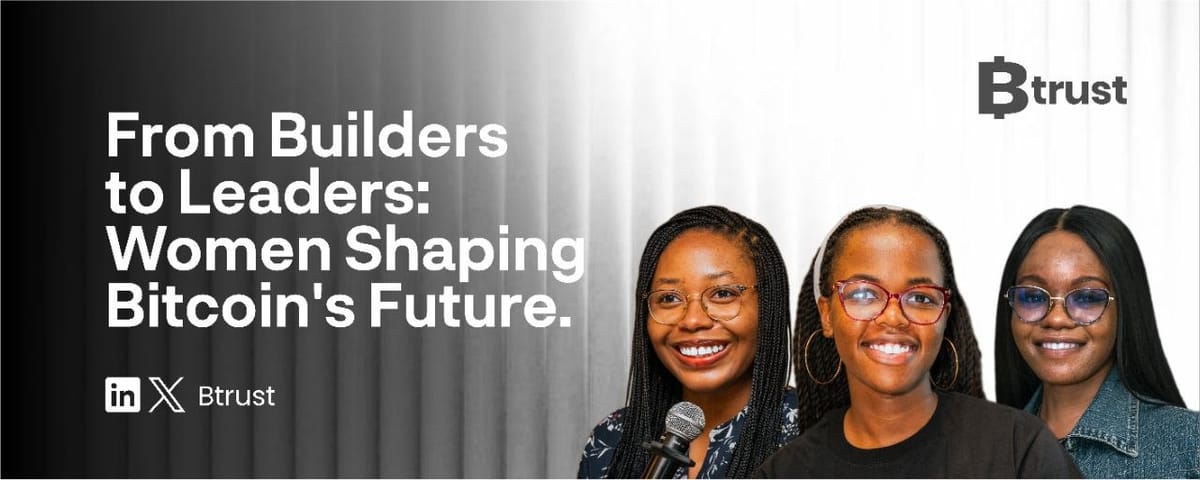
In this article, we are spotlighting three Btrust grantees whose work shows what that future can look like. Rita Anene is building Lightning infrastructure full-time. Jemimah Nagasha moved from public infrastructure into Bitcoin infrastructure. Enigbe Ochekliye is contributing to the Lightning Dev Kit ecosystem through engineering and research.
Three women. Three different paths. One shared commitment to building.
Rita Anene: Building Lightning Infrastructure Full-Time
Rita had spent over three years working as a software developer when she began to feel that she wanted something deeper. She was good at her job, but she wanted to work on technology that felt more foundational. She wanted to build something that could change how people relate to money, not just how a product works.
She first heard about Bitcoin in 2018. At the time, she understood it the way many people do at first: as internet money. She did not think too much about it and moved on. But in 2024, she discovered the development ecosystem behind Bitcoin. She found people maintaining the infrastructure, debating design choices, reviewing code, and building tools that support real-world use. That discovery changed everything.
It led her to Btrust, and then to the BOSS program, run in partnership with Chaincode Labs. The program was demanding, and Rita was still working a full-time job while taking part in it. But she stayed committed. She read Bitcoin chapters on her commute, used her weekends to study, and coded late into the night after work.
She later joked that she became a “vampire coder”, but what really stood out was her focus. She kept showing up because the work had become meaningful to her.
By Week 4 of the program, the Lightning Network clicked. Its design captured her attention, and the Lightning challenges quickly became the ones she solved fastest.
Her first contribution was integrating Circuit Breaker into Warnet, a Bitcoin and Lightning network simulator. She still remembers how nervous she felt when she forked the repositories. Her hands were shaking. But she opened the pull request, went through several rounds of review, and eventually, it was merged.
From there, Rita found her technical home in LDK Node, a Lightning implementation in Rust.
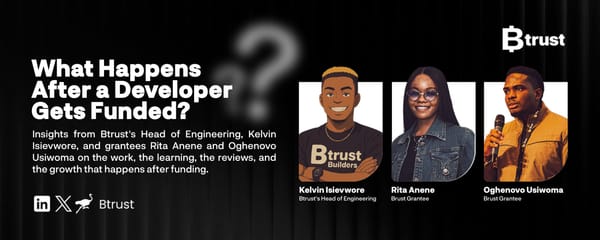
By January 2025, she started attending BitDevs Lagos, and by June, she was hosting sessions. In Q3 2025, she received the Btrust Starter Grant and moved into full-time open-source Bitcoin development.
Today, Rita works on LDK Node full-time. One of her recent contributions rebuilt payment store synchronization into an event-driven architecture. She then used that foundation to implement fee-bumping for unconfirmed transactions. It is careful, important work that helps shape how Lightning nodes behave for the people and applications that depend on them.
Read more about her here.
Jemimah Nagasha: From Public Infrastructure to Bitcoin Infrastructure
Nagasha was managing public infrastructure projects in Uganda when she started learning frontend development on the side. She wanted more flexibility, but she also enjoyed building things people could actually use.
As she learned more, her curiosity grew. She wanted to understand systems more deeply. How do they scale? How do they fail? How can they give people more control over their lives?
That curiosity led her to the first BitDevs Kampala event. There, Bitcoin began to feel different. It was no longer just something she had heard about. It became a serious technical system she wanted to understand.
At that same event, she heard about the Btrust Builders Program from an alumnus. She applied, and that decision opened a new path for her.
The program took her from Bitcoin fundamentals into the Btrust Builders Fellowship. She began decoding transactions, creating Lightning channels, and studying open-source projects to understand the problems they were trying to solve. She also started contributing to Polar, a tool that helps developers run Bitcoin and Lightning nodes locally. Her work helped improve the experience for other developers who need a simpler way to build and test.
And she was doing all of this while still working full-time as a civil engineer.
What started with attending BitDevs Kampala soon became organising it. By 2025, Jemimah was leading the community. She also joined the Btrust Builders faculty, where she began mentoring the next cohort and sharing the same kind of support that had helped her grow.
In April 2026, she received the Btrust Starter Grant and made the full transition into Bitcoin open-source development. She no longer had to split her time between construction drawings and Bitcoin code.
“This journey has given me more than technical skills,” she wrote. “It has given me a community, a sense of purpose, and the chance to build tools that make Bitcoin more accessible.”
Learn more about her story here.
Enigbe Ochekliye: Strengthening Bitcoin Through Research and Engineering
Enigbe is a Lightning developer based in Nigeria. Her work focuses on Lightning Network infrastructure and research, especially within the Lightning Dev Kit ecosystem.
Her path into this work is grounded in both engineering and systems thinking. She holds a Master’s in Energy from the University of Auckland, where she completed graduate-level coursework in multivariable control systems. She also holds a Bachelor’s in Mechanical Engineering from Ahmadu Bello University.
That background gives her a unique lens for thinking about Lightning. The network is not just software. It is a live system, with many moving parts, many actors, and constant changes in liquidity, routing, and reliability. Enigbe’s work sits at the place where practical engineering and deeper research meet.
Over the past couple of years, she has contributed to the LDK ecosystem through code development, reviews, and technical research. Her work includes improvements to logging infrastructure, chain synchronization features, and infrastructure reliability across LDK components. These are the kinds of contributions that help developers and node operators run more dependable systems.
Enigbe is currently pursuing research into distributed control systems for Lightning Network liquidity management. In simple terms, she is studying how Lightning can be understood as a network of independent actors that still need to coordinate with one another. Her work models Lightning as a multi-agent dynamical system and explores how decentralized controllers can help coordinate liquidity distribution across the network.
This research will combine theory with practice. Part of the work will happen through academic exploration, and part of it will be implemented inside ldk-node and simulation environments. The goal is to contribute not only new ideas, but also open-source engineering improvements that can be tested, reviewed, and built on by others.
Enigbe is also the first member of the Btrust Open Source Cohort to focus on research. That matters because it expands what contribution can look like within the program. Open-source work is not only about writing code. It is also about asking hard questions, testing ideas, studying systems, and turning research into tools that make the ecosystem stronger.
Building the Future, Together
Rita, Jemimah, and Enigbe are part of the future Btrust is investing in: a future where more women across Africa and the Global Majority have the support, funding, mentorship, and community they need to become serious contributors to the Bitcoin open-source ecosystem.
Their stories are not about waiting for permission. They are about choosing to learn, staying with difficult problems, contributing to important tools, leading communities, and making the path clearer for others.
That last part matters more than it might seem. For many developers, the journey into Bitcoin does not begin with a grant or a formal program. It begins in a room, at a local BitDevs meetup, where people are asking questions, discussing technical ideas, and slowly making Bitcoin feel less abstract. Btrust supports the largest network of BitDevs chapters in Africa, with more than 13 communities across the continent. Several of these chapters are led by women, which makes them even more powerful as entry points. When women lead technical spaces, other women can walk in and see that they belong not only as learners, but as contributors and leaders too.
And Btrust is not the only organisation building this pipeline. Initiatives like Hack4Freedom, Dada Devs and Africa Free Routing’s Lightning Bootcamps are also creating pathways for women in the Bitcoin ecosystem. They are training developers, building communities, and helping expand who gets to take part in this work.
And that matters because the movement is bigger than one organisation. It is a growing network of people making Bitcoin development more open, more accessible, and more representative of the world it hopes to serve.
If you are a developer watching from the outside, or someone who is simply curious but unsure where to begin, there is room for you here. You do not need to already know Rust. You do not need a computer science degree. You do not need to have everything figured out before you start.
Una comparación útil de camisetas de fútbol para regalo comienza por las medidas reales y el tipo de ajuste preferido. El pedido puede cerrarse después de confirmar las condiciones de cambio antes de personalizar la prenda.
Curiosity is enough for the first step. Consistency will carry you further. And with the right community around you, the things that feel difficult now can begin to make sense.
Bitcoin’s future will be stronger when more people can help build it. Rita, Jemimah, Enigbe, and many others are already showing what that future can look like.