2025 Btrust Developer Grantee Impact

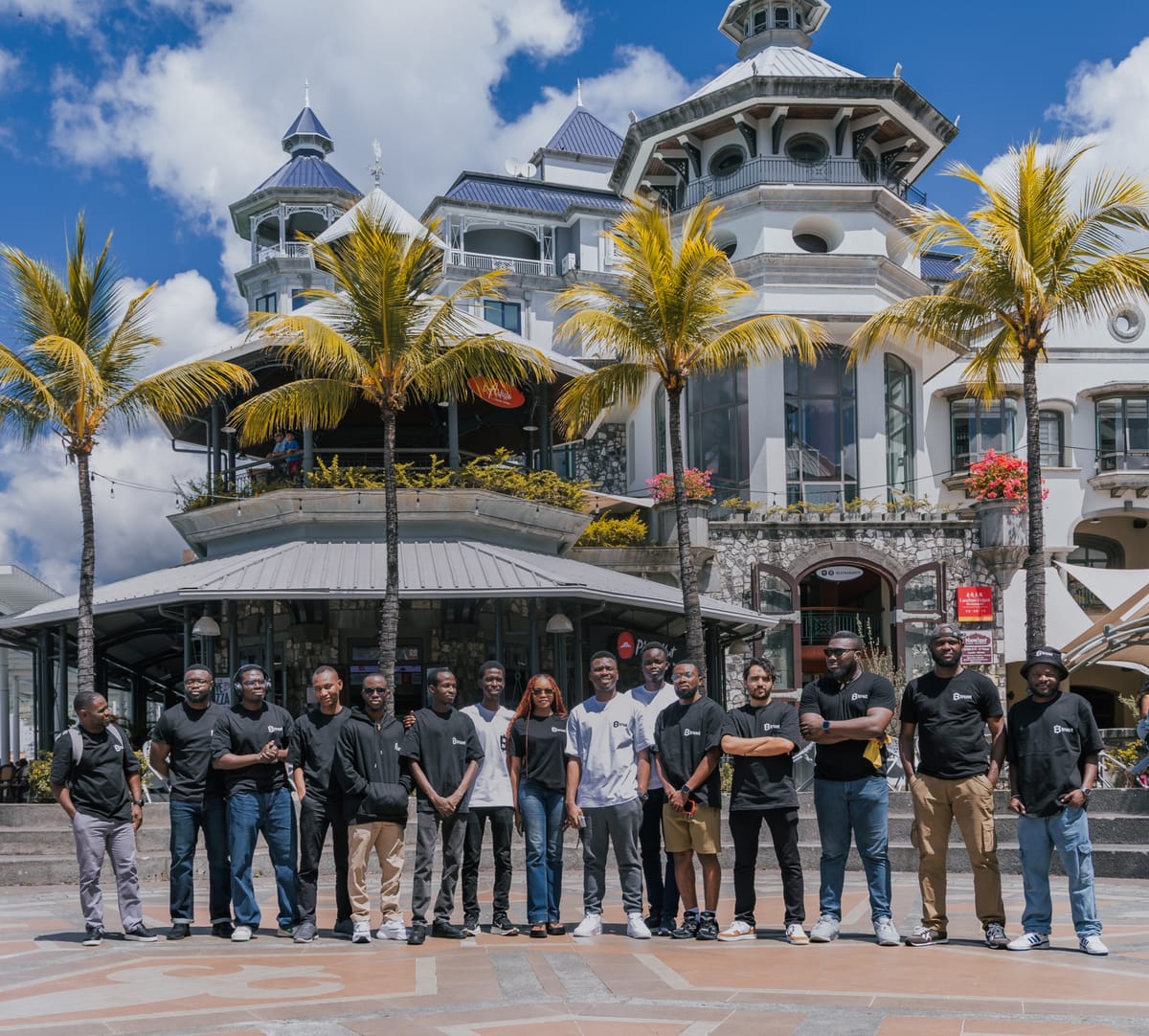
At its core, Bitcoin is sustained by people; developers who review code, fix bugs, debate tradeoffs, and quietly maintain the software that powers a global monetary network.
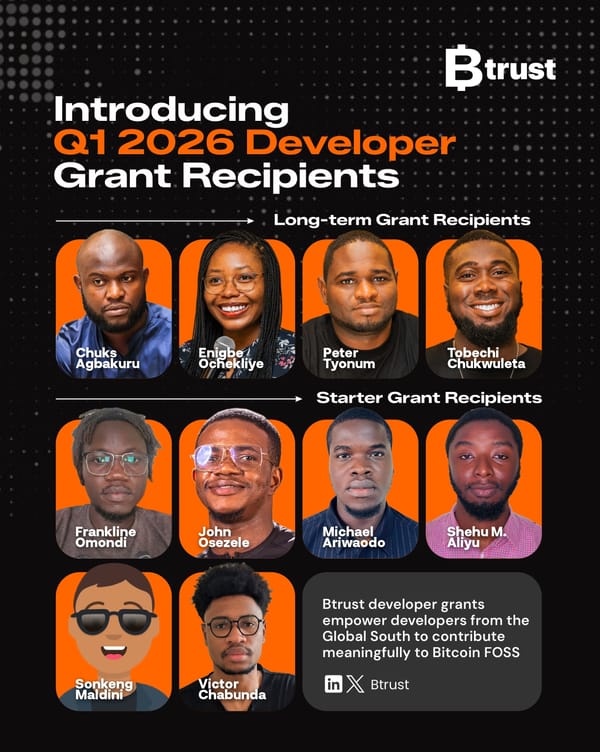
In 2025, Btrust’s support of open source development efforts were guided by a belief that when developers from Africa and the Global Majority are given sustained support, they can become long‑term stewards of Bitcoin’s open‑source infrastructure.
Towards the end of 2024, we welcomed a new Engineering Lead, marking a shift from early experimentation to deliberate scaling. In 2025, this translated into stronger systems, clearer expectations, and deeper technical engagement, all designed to support developer grantee impact.
This leadership transition catalysed significant structural improvements across two key programs:
- Btrust Builders Program: Our hands-on, technical training arm that mentors new African software developers and helps them make their first contributions to Bitcoin open source development.
- Btrust Grants Program: A support system for developers actively contributing to Bitcoin open-source projects, as well as events, conferences, and educational initiatives that deepen the Bitcoin open-source contributor ecosystem.
H1 2025: Foundation And Structural Improvements
The first half of 2025 focused on improving the systems that support developer grantees, from onboarding to funding decisions.
Strengthening The Developer Pipeline
Developers need time, mentorship, and structured learning environments to meaningfully contribute to Bitcoin's open-source ecosystem.
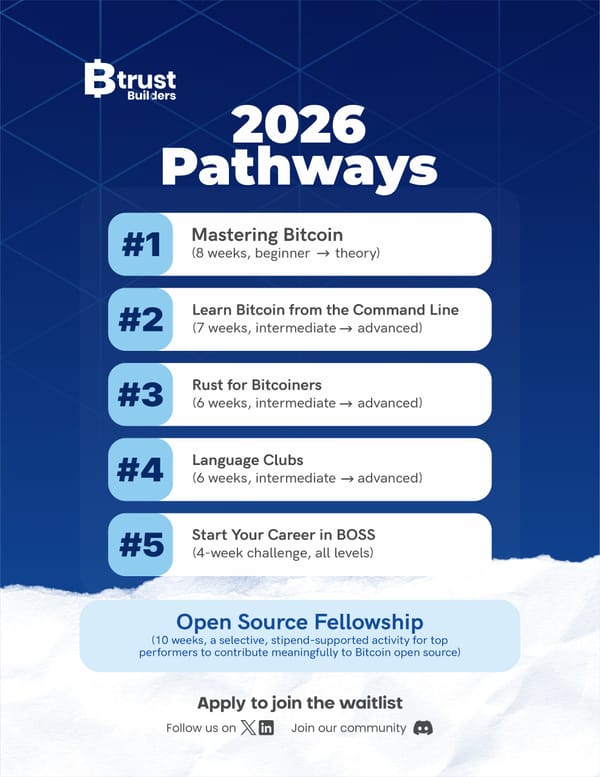
The Btrust Builders program serves as an important entry point into that pipeline, helping aspiring developers gain the technical foundations required to eventually contribute to Bitcoin open source projects and qualify for developer grants.
In 2025, Btrust Builders supported 493 developers across our five technical pathways, with more than 1,800 applications received from across Africa and beyond.
In addition, the launch of our first Open-Source Bootcamp marked a major milestone for us, where 40 top graduates from the Mastering Bitcoin and Bitcoin CLI pathways gained hands-on experience contributing to Bitcoin open-source projects including Bitcoin Core, BDK, Polar, BlueWallet, Rust-Payjoin, and BTCPay Server.
For a deeper look at the program structure and outcomes, read the full 2025 Btrust Builders year in review blog.
Reimagining The Btrust Developer Grants Process
We also restructured our grant review process by introducing clearer requirements and establishing a dedicated sub‑committee of experienced Bitcoin open‑source contributors.
This change reduced average review time from 4 months to under 2 weeks, making it easier for developers to access timely support, and brought greater transparency, consistency, and fairness.
H2 2025: Scaling And Deepening Impact
The second half of the year focused on optimising our processes and expanding opportunities for our highest-performing grantees.
Two of our long-term grantees, both Bitcoin Core contributors, under the Btrust Pull Partnership, were invited to the 2140 office in Amsterdam to gain experience working alongside other Bitcoin Core developers. We believe collaborative partnerships like these help bridge geographic distances in open-source communities and ensure that voices from the Global Majority are part of Bitcoin’s core technical evolution.
Meanwhile, our collective grantees made their own mark, authoring over 200 PRs across 15 Bitcoin open-source projects and publishing 7 articles on our blog, covering topics ranging from personal journeys into Bitcoin open-source to Bitcoin Core protocol development.
2025 Grantee Impact By The Numbers
Program Growth And Ecosystem Expansion
2025 was a significant year of growth for the Btrust developer grantee program, both in the number of contributors supported and the Bitcoin open-source projects they contributed to. Active grantees (starter and long-term) grew from 5 to 18, representing a 260% increase over the previous year.
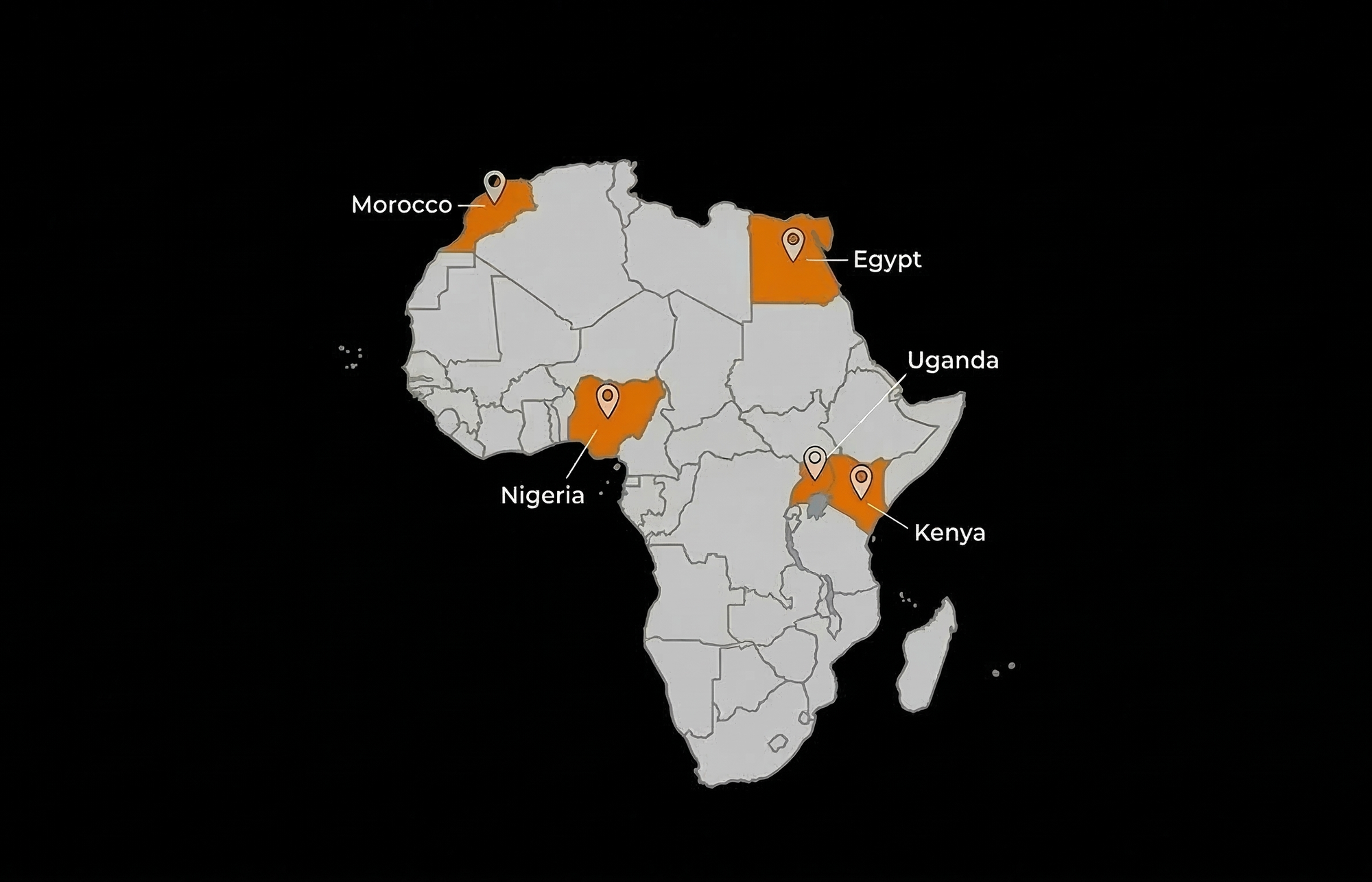
At the same time, the program's geographic footprint expanded beyond its strong base in Nigeria to include Kenya, Uganda, Morocco, and Egypt, reflecting a growing pool of open-source Bitcoin talent across the continent.
Alongside this growth in contributors and geography, grantees also expanded the range of projects they contribute to. In 2025, Btrust grantees were actively contributing to 15 Bitcoin open-source projects spanning multiple layers of the Bitcoin stack, including protocol development, scaling infrastructure, privacy tools, and end-user applications. These projects include:
- Protocol/Base Layer: Bitcoin Core, Rust-Bitcoin, BDK, BDK-CLI, BitcoinJ
- Scaling Solutions: LDK Node, LDK Server, LND, Stratum V2, Polar
- Privacy & Wallets: BlueWallet, Payjoin, Coinswap, BTCPay Server, VLS
Aggregate Performance Metrics
Performance across all 15 projects for the 2025 period:
| Metric | Value |
|---|---|
| Total Commits | 431 |
| Pull Requests Merged | 222 |
| Pull Requests Open | 63 |
| PRs Reviewed (Peer Review) | 475 |
| Issues Resolved | 154 |
| Bug Fixes | 44 |
| New Features Implemented | 56 |
| Code Refactors | 25 |
| Test Coverage Improvements | 21 |
| Documentation Contributions | 36 |
| Technical Articles Published | 8 |
High-Impact Project Spotlights
The impact of our grantees was felt across multiple layers of the Bitcoin stack, from protocol improvements to end-user applications and the following sections highlight the specific projects, and technical areas where these contributions had the most impact.
Bitcoin Core Contributions
Our grantees represent a significant portion of the specialized workforce contributing to Bitcoin's base layer.
Key Metrics
- 364 PR reviews performed on Bitcoin Core, directly addressing the protocol's well-known review bottleneck
- 52 PRs merged with 43 commits
- 12 PRs currently open
Contributions Breakdown
- 7 New Features
- 15 Bug Fixes
- 12 Test Improvements
- 4 Refactors
- 5 Documentation Updates
Highlights of Bitcoin Core Contributions
- Schnorr Batch Verification: Eunovo implemented batch verification of Schnorr signatures, significantly improving validation speed
- Silent Payments: Eunovo integrated Silent Payments into Core; a major advancement for on-chain privacy. Sending and receiving support now available on Bitcoin Core GUI
- Mempool-Based Fee Estimation: Abubakar Sadiq Ismail introduced new fee estimation logic to reduce overestimation during volatile market periods
- Code Review of various projects (Cluster Mempool, Libbitcoinkernel and Mining interface)
- Bug fix: Abubakar Sadiq Ismail resolved an issue in the Bitcoin Core block template assembler.
- Brandon Odiwuor fixed TestShell initialization issues caused by symlinks resolution.
- Brandon added unit test to handle case where the CLI returns an empty string, ensuring it is correctly interpreted as None in RPC tests.
- Brandon made several CI updates, including:
- Updating the asan-lsan-ubsan-integer-no-depends-usdt workflow to use the Mold linker for faster builds.
- Removing bash -c from the CMake invocation and replaced it with eval for cleaner command execution.
Lightning Development Kit (LDK)
- Bitcoin Core Chain Synchronization: Enigbe integrated Bitcoin Core as a chain data backend via its REST API, enabling full block-level synchronization and providing node operators with an alternative to third-party Esplora/Electrum indexers.
- Configurable Logging Infrastructure: Enigbe built a pluggable logging system targeting different backends, and giving integrators full control over observability in deployments.
- Multi-tier Data Storage Architecture: Enigbe implemented a tiered KVStore system that separates critical channel state, ephemeral data, and disaster-recovery backups across independent storage backends, enabling safer, more flexible deployment.
- BIP-353 Integration: Chuks integrated BIP-353 into LDK-Node. This significantly improves usability by making it possible to securely send payments to Human-Readable Names.
- Replace-By-Fee (RBF) and Event-Driven Transaction Management: Rita rebuilt payment store synchronization from full-transaction polling to BDK's wallet event stream, then leveraged this event-driven architecture to implement fee-bumping (RBF) for unconfirmed on-chain transactions and automatic background rebroadcasting with configurable attempt limits.
LND (Lightning Network Daemon)
Work on LND included contributions aimed at improving usability, reliability, and development stability. Abdullahi Yunus contributed to several improvements, including:
- UX Improvements: Added pagination to wallet transactions
- RPC Updates: Updates to RPC, including an extension to pathfinding for routes and a tracking addition to htlc forwarding events.
- Persistence: Ensured node announcement configurations persist across restarts. Added a second-layer backup for channels via archives.
- Test Flakes: Participated in hunting and addressing various CI flakes
Validating Lightning Signer (VLS)
Contributions were also made to Validating Lightning Signer (VLS), focusing on reliability, security, and operational efficiency. Sulaiman Aminu Barkindo worked on several improvements, including:
- Infrastructure and Reliability: Led critical persistence layer upgrade from Redb 1.5 to 2.2.0 with seamless automatic migration, ensuring zero-downtime upgrades for production deployments across vls-persist and LSS components.
- Security and Fund Safety: Enhanced fund recovery and security by implementing comprehensive second-level HTLC tracking, fixing sweep transaction vulnerabilities in unilateral close handling, and establishing anchor channel recovery infrastructure for zero-fee HTLC channels.
- Performance Optimization: Streamlined core operations by eliminating redundant commitment validation checks and optimizing monitoring to track only spendable HTLCs, reducing resource overhead.
- Team Collaboration: Accelerated delivery through code reviews across multiple critical PRs in a small, high-impact team.
Bitcoin Development Kit (BDK)
Peter Tyonum worked on several enhancements to BDK, including:
- Hardware Wallet Support: Added native hardware wallet support to the BDK binary crate, demonstrating how users can bridge the gap between mobile apps and cold storage
- Worked on a minimal, experimental Bitcoin Core RPC client for the Bitcoin Dev Kit (BDK), with a focus on data emission and strict type safety, with built-in support for multiple Bitcoin versions
- Added wallet config subcommand, which allows users to persist wallet configurations to a local configuration file for ease and reuse, improving the UX of the binary crate
- Contributed to shipping versions 1 and 2 of the CLI binary crate
- Introduced --pretty flag to the CLI to transform standard JSON or raw text outputs into human-readable ASCII tables
- Introduced a descriptor generator to the binary crate to help users create valid output descriptors without having to manually string together complex scripts.
Language Bindings for BDK (BDK-FFI)
Bitcoin Dev Kit BDK-FFI received several improvements from Itoro Ukpong, including:
- Enhanced the PSBT implementation to allow easier access to inputs and outputs. This improvement enables the
signmethod to return a mapping of input indices to the keys used for signing. - Improved the user interface of the BDK-FFI Android sample app by enabling users to easily copy their generated Bitcoin addresses.
- Created a script that allows Windows users to build the BDK-FFI library locally on their windows machine.
- Added public_descriptor support to the wallet implementation.
- Added a wallet setup example for JVM binding.
- Tested new library releases and provided feedback, bug reports, and fixes for identified issues.
Bitcoinj library
Itoro Ukpong made several refactors and enhancements to the Bitcoinj library, including:
- Introduced a Kotlin module to the Bitcoinj project.
- Ensured version compatibility between the Kotlin and the versions supported by Bitcoinj.
- WalletTool: Created a design document outlining the structure and functionality of WalletTool subcommands.
- Contributed to the migration of WalletTool to a subcommand-based architecture.
- Removed deprecated Guava Joiner and Splitter utilities to modernize the codebase.
- Wallet refactoring: Contributed to ongoing wallet refactoring efforts, aimed at simplifying the core wallet class and aligning it with modern Java development practices.
Rust Bitcoin
Jamal Errakibi made several refactors and enhancements to the Rust Bitcoin library, including:
- Added a feature to align with Bitcoin Core policy by reducing the minimum non-witness transaction size from 82 to 65 bytes.
- Introduced a CoinbaseTransaction newtype to clearly distinguish coinbase transactions from other transaction types.
- Standardize BIP notation across the codebase to the BIP-XXXX format.
- Consensus Encoding improvements:
- Added a new() constructor to CompactSizeDecoder.
- Implemented CompactSizeEncoder and refactored WitnessEncoder.
- Added functional tests for assumeUTXO in Bitcoin core.
BTCPay Server
Tobechi contributed several integrations and plugins, including:
- Shopify Integration: Developed an open-source payment gateway enabling merchants to accept Bitcoin payments directly through their Shopify stores with zero fees. While the standalone Docker image has recorded over 1,000 direct downloads, the plugin is also used by hundreds of merchants running BTCPay Server on managed infrastructure platforms like Start9 and Voltage, indicating broader real-world adoption beyond direct downloads.
- Cal.com Payment Integration: Enabled Bitcoin and Lightning payments for appointments and bookings on Cal.com, an open-source scheduling platform. The implementation supports both Bitcoin and Lightning invoice payments
- Naira Checkout Integration with Mavapay: Created a plugin allowing Nigerian customers to pay in Naira while merchants receive Bitcoin. Recently expanded to include payout functionality supporting:
- Nigerian Naira (any Nigerian bank)
- Kenyan Shilling (bill payment, till number, account number)
- South African Rand (South African banks)
- Satoshi Tickets Plugin: Built a plugin enabling event organizers, conference hosts, and community managers to sell tickets and accept Bitcoin payments via BTCPay Server. The plugin has so far been known to have been used in about 3 events and conferences, processing close to a thousand tickets, with millions of sats in transaction value.
- Payroll Plugin: Built a payroll plugin that enables businesses in Africa and globally to manage payroll and salary payments using Bitcoin via BTCPay Server. The plugin is currently used by multiple organizations, including BTC Inc, to execute recurring and bulk salary payments, moving significant volumes of bitcoin and supporting real-world, non-custodial payroll operations.
Looking Ahead: 2026 Priorities
In 2026, we intend to build on the momentum created by our developer grantees last year by:
- Scaling the Btrust Builders program and grantee pipelines to onboard more contributors.
- Strengthening Bitcoin Core’s contributor and review capacity by supporting and growing the pool of long-term open-source contributors.
- Deepening technical contributions while ensuring high standards of code quality and mentorship.
- Ensuring more cross-collaboration between Global Majority developer contributors.
- Encouraging open-source project spearheading by Global Majority developer contributors.