What Happens After a Developer Gets Funded?
A Btrust grant is easy to see as a finish line. A developer applies, the work is reviewed, the funding is announced, and the congratulations follow. Then the announcement fades from view and the developer gets back to work.
This is where the more interesting part begins.
A grant gives a developer something that can be difficult to find while working another job: enough time to stay with a problem. It creates room to work through difficult code, learn from maintainers, try again when an approach does not work, and take on contributions that would be difficult to sustain in a few spare hours each week.
Rita Anene knows what that difference feels like. Before her Btrust grant, she was a backend engineer fitting Bitcoin development around her full-time job. She could spend a Saturday working through a problem, only to return to it days later and spend part of that time remembering where she stopped. Today, she contributes to LDK Node, the Lightning Development Kit's node implementation, and works on problems that require much more sustained attention.
Rita is one of 18 developers Btrust funded in 2025. Together, the group made 431 commits, merged 222 pull requests, and resolved 154 issues across 15 Bitcoin projects. Among them was Oghenovo Usiwoma, known as Novo, who works on Bitcoin Core.
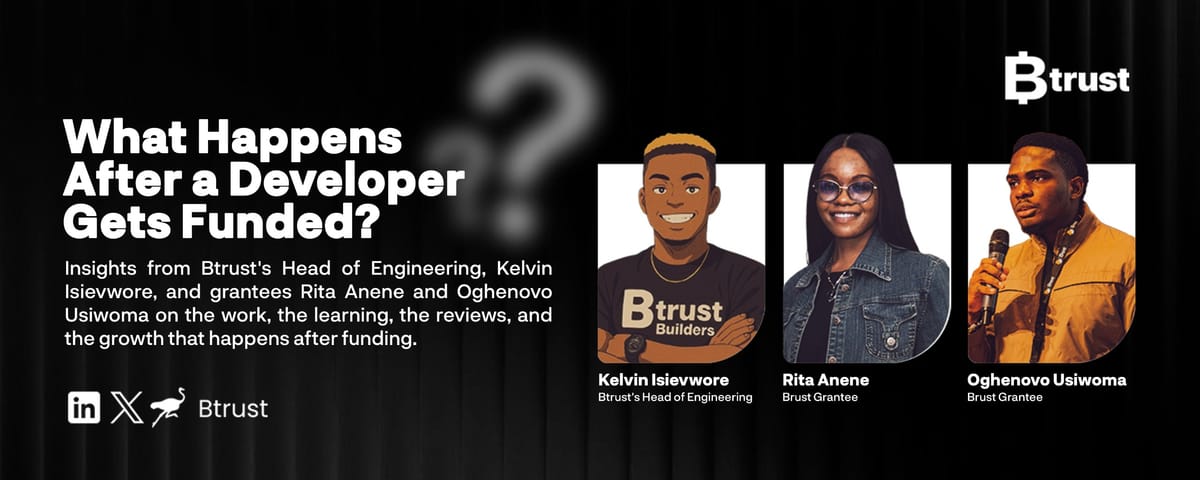
We spoke with Rita, Novo, and Kelvin Isievwore, Btrust’s Head of Engineering, about what happens after the funding announcement: how the work changes, how developers grow, and what stays with them when a grant period ends.
Funding Comes After the Groundwork
By the time Btrust considers a developer for funding, they have usually spent time learning, contributing, and finding their way through open source. They may have come through Btrust Builders, a BitDevs community, or the similar program. They have worked in unfamiliar codebases, opened issues, submitted pull requests, and responded to feedback from maintainers.
As Kelvin explains, the question is not just whether someone understands Bitcoin, it is if they have shown they can contribute to its open-source projects, and whether more time and support would help them do more.
That is why Btrust invests in the stages that come before a grant, supporting events where developers can discover Bitcoin open source and education programs that help them build the skills to start contributing.
The aim is to build a path from learning about Bitcoin to making a first contribution, then gradually taking on more sustained work. A grant supports developers who have already started down that path.
For Rita, it meant she could stop fitting contributions into the gaps between other responsibilities and give difficult problems the attention they needed.
Time Makes Deeper Work Possible
When time is limited, developers often choose tasks they can finish in the hours they have. With more time, they can take on work that requires a deeper understanding of a project.
Rita’s work on Replace-By-Fee (BIP 125) support in LDK Node is one example. To implement it, she had to understand how transactions move through the node, rather than focus on one isolated part of the code. Later, she worked on making the node’s payment store synchronisation event-driven, another change that required her to understand how several parts of the system fit together.
Novo used his grant to move deeper into Bitcoin Core. His work on Schnorr batch signature verification and Silent Payments took him into areas that demand a strong understanding of the project’s internals.
Work like this does not always produce a steady stream of merged pull requests. A developer might spend days reproducing a bug, writing tests, reviewing someone else’s code, or discussing an approach before they begin an implementation. They might investigate a problem for two weeks and end up with one small PR.
That is why Kelvin looks beyond the number of contributions merged. He wants to know whether a developer is doing useful work and becoming more capable of doing it independently. The size of the final change does not always reflect the effort or judgement behind it.
The Work Behind a Pull Request
Rita estimates that writing the first version of a contribution is about a third of the job. The rest is getting it ready to merge: responding to comments, updating it as the codebase changes, testing again, and explaining why she made certain decisions. Sometimes, a maintainer’s feedback means reworking much of the implementation.
Her work on LSPS5 webhook support for LDK Node shows how much can happen during that process. The feature allows a service to send notifications through a webhook, helping address situations where a Lightning client is offline when a payment is waiting.
During review, Rita and the maintainer found a limitation in the existing configuration model. It supported only one Lightning Service Provider per protocol, which was too restrictive for the feature.
Rather than work around the limitation, Rita proposed a change that would let a node support multiple providers and identify which protocols each one supported. That became a separate contribution and was merged independently, giving the webhook work a foundation to build on.
She also had to work through how the service would detect a payment waiting for an offline client and which event should trigger the notification.
The final code captures the solution, but it does not reveal every question, conversation, or discarded approach that led to it. Funding gives developers time to work through those decisions rather than stop at an initial implementation.
Becoming Part of the Community
As developers spend more time on a project, they also learn how to work with the people around it.
For Kelvin, access to maintainers and experienced contributors is an important part of that growth. Knowing how to write code is not the same as knowing which problems need attention, how to approach them, or when to rethink a solution.
"Open source in general can be difficult to navigate, especially when you're contributing to mature projects with experienced contributors and maintainers," Kelvin said. "Knowing what to work on is sometimes just as important as knowing how to implement it, and the broader community matters because open source isn't just about the repository. It's also about relationships and trust."
Those relationships develop through repeated contributions. Over time, someone who submits a first PR can become a contributor whom maintainers recognise and rely on.
Rita’s work with LDK Node maintainer Elias Rohrer helped her make that transition. Each round of review taught her more than how to fix a particular issue. It helped her learn how to think through a contribution, question her choices, and explain her approach.
She now shares that experience with others. Alongside mentoring newer contributors, Rita spoke about her replace-by-fee work at bitcoin++ Nairobi and led a session on Lightning payment flows at Hack4Freedom Lagos.
Novo describes a similar change in how he works. Contributing consistently has made him more patient, more open to being challenged, and more comfortable with the slower pace of a project where correctness matters more than speed.
Learning to Work Independently
For Kelvin, one of the clearest signs of progress after six months or a year is a developer’s growing independence.
At first, they may need someone to point them towards the right file, documentation, or issue. With experience, they become better able to find a problem, investigate it, propose a solution, and take it through review without guidance at every step.
Rita sees that progress in the work she can now take on. She can read a BIP, a bLIP, or another technical specification, work through unclear details, and turn it into an implementation. Some of those tasks would have been beyond her before the grant.
Her understanding of Rust has grown too. What was once a language she could work with is now one she can use confidently at a systems level. She credits much of that growth to the quality of review in Bitcoin and Lightning projects, where contributors are expected to explain their decisions and get the details right.
She has not just become more familiar with the code. She has become better at deciding how to change it.
What Stays After the Grant?
Funding gives developers time, but it does not remove the difficulty of the work. They still have to understand large codebases, find useful problems, communicate with maintainers, and respond to criticism. Through that process, they build knowledge and relationships that can last beyond the funding period.
Asked what the grant gave her beyond money, Rita described it as permission and continuity: the space to move from being “someone interested in Bitcoin development” to “an open-source contributor with a track record”.
That record stays with her, along with the technical skills, relationships, and confidence she has built by taking difficult work through review.
Kelvin sees the same pattern across the developers Btrust supported in 2025. They are contributing to Bitcoin Core, Lightning infrastructure, wallets, privacy protocols, and payment systems. Their progress reflects not only their technical ability, but also the time, mentorship, and community support that helped them keep going.
For Btrust, this is part of building the next generation of Bitcoin contributors across Africa and the Global Majority. The goal is to help developers move from discovering Bitcoin to contributing regularly, until they become people other contributors can rely on.
For Rita and Novo, that work continues. Rita is contributing across the LSPS series and Payjoin V2, while Novo continues his work on Bitcoin Core.
The grant announcement is the moment people notice. Its lasting value becomes clearer in the months that follow, as developers learn, build, respond to review, and earn the trust to take on more.
Take the Next Step With a Btrust Grant
If you’re contributing to Bitcoin open source and want more time to deepen your work, a Btrust developer grant could help you take that next step. We offer more than funding. We’re building an ecosystem of support where developers can learn from experienced contributors, connect with peers, and grow into sustained open-source work. Explore our grants and apply to build on the contributions you’ve already started.