Introducing the 2026 Open Source Fellowship
Last year, we ran our first Open Source Bootcamp with a goal of making Bitcoin open-source contribution feel less intimidating.
Many developers in our Builders pathways had the technical foundation to contribute, but they were unsure how to get started. They did not always know how to navigate a large codebase, choose an issue, open a pull request, or communicate with maintainers.
So, we created a four-week space where they could learn by doing. The response was better than we imagined.
Looking Back at Our First Open-Source Bootcamp
We welcomed 38 developers from Nigeria, Kenya, Bénin, Uganda, Malawi, Ghana, and Brazil. Over four weeks, participants learned about Bitcoin, set up their development environments, explored open-source projects, reviewed code, and made their first contributions.
Together, they:
- Made more than 100 code submissions
- Contributed to over eight Bitcoin open-source projects
- Submitted 12 pull requests, including three to Bitcoin Core
- Completed six code reviews
- Reported five new issues
- Worked directly with maintainers and other contributors
But the numbers only tell part of the story. After the bootcamp, some participants went on to secure fully funded careers in open source through different organizations. Others started projects of their own. Many continued contributing, learning, and building across the Bitcoin ecosystem.
We saw what could happen when talented developers received the right structure, support, and encouragement. That experience shaped what came next.
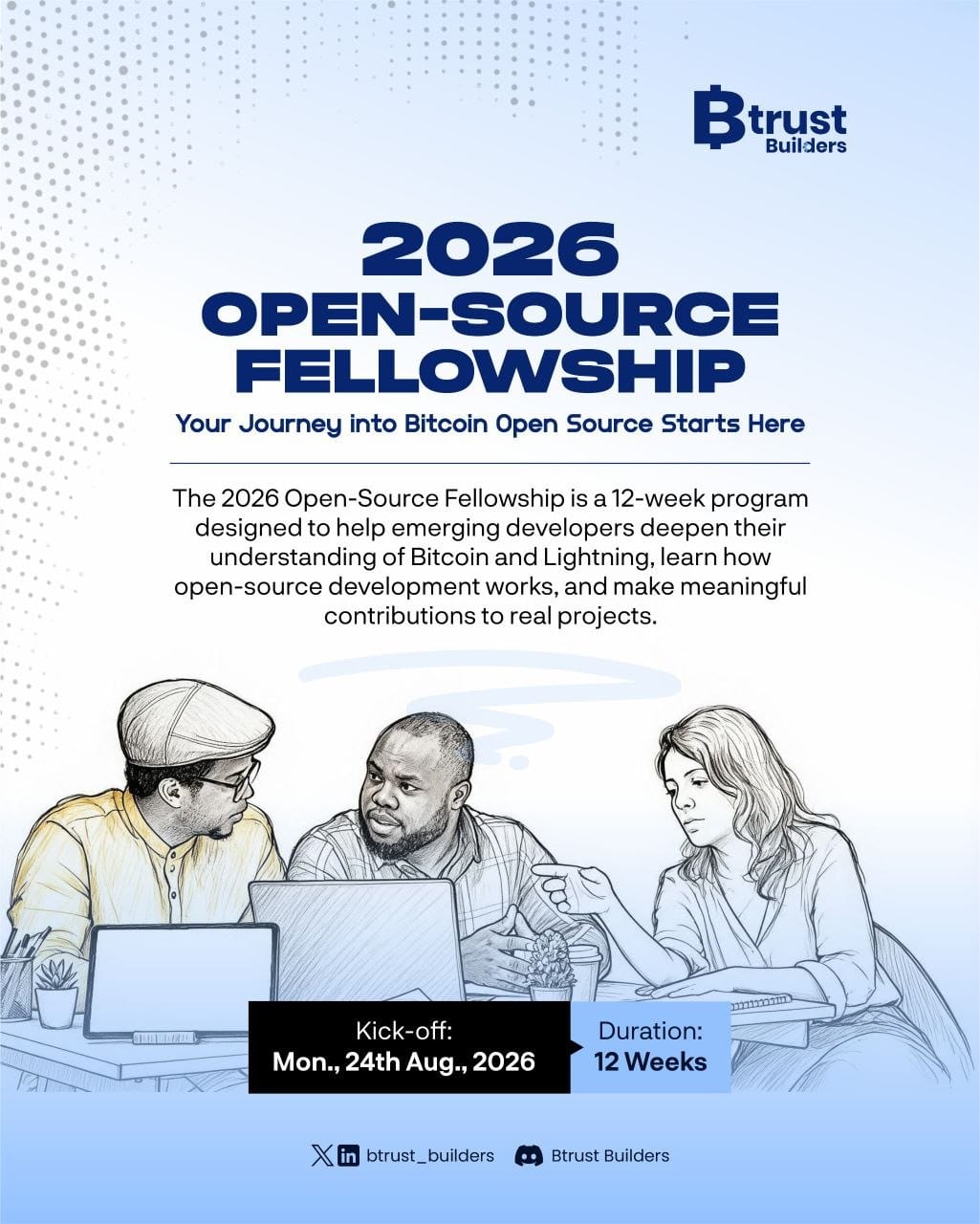
Introducing the 2026 Open-Source Fellowship
The bootcamp has evolved into a longer and more in-depth program; the 2026 Open-Source Fellowship.
The fellowship is a 12-week, part-time program designed to help high-performing developers move from technical learning to meaningful contribution in Bitcoin open source. It will run from 24th August to 13th November 2026, beginning with a kick-off bootcamp on Monday, 24th August.
This year’s fellows are top performers from our 2026 Builders Pathways. They have already demonstrated strong technical ability, curiosity, and commitment. The fellowship will give them the opportunity to deepen those skills and apply them in real open-source communities. Fellows will also receive a stipend during the program.
What Will Fellows Work On?
The fellowship follows a clear progression over three months, taking fellows from protocol fundamentals to practical open-source contribution.
Month 1: Bitcoin and Lightning Protocols
Fellows will begin by building a deeper understanding of how Bitcoin and the Lightning Network work. They will explore topics such as Bitcoin’s security model, SegWit, mining, peer-to-peer networking, Script, wallets, payment channels, HTLCs, routing, liquidity, and the future of Lightning. Through self-directed study, study partnerships, and group discussions, fellows will strengthen the protocol knowledge needed to contribute confidently to Bitcoin open source.
Month 2: Open-Source Practice and Bitcoin Core
In the second month, fellows will learn how open-source projects work in practice, using Bitcoin Core as their main case study. They will set up Bitcoin Core, run a local development environment, explore its architecture, read code and tests, trace RPC commands, and learn how debugging and testing work. They will also review issues and pull requests while becoming familiar with contributor guidelines, review culture, communication channels, and the collaborative practices that support open-source development.
Month 3: Project Selection and Contribution
In the final month, fellows will choose a Bitcoin or Lightning open-source project and begin contributing with support from a mentor. They will identify suitable issues, write design documents, claim tasks publicly, develop and test their solutions, and submit pull requests. Fellows will also learn how to respond to maintainer feedback, participate in technical discussions, and build a public proof-of-work portfolio that brings together their contributions, writing, reviews, and learning from the fellowship.
By the end of the fellowship, fellows will have moved beyond learning about open source to actively participating in it. They will have built a public record of their work through code contributions, technical writing, issue and pull request discussions, reviews, and maintainer engagement. These experiences will come together in a public proof-of-work portfolio, allowing each fellow to clearly demonstrate not only what they know, but what they can do.
Learning Together
The open source environment is collaborative, so the fellowship will not be a solo learning experience. Fellows will be placed in small homegroups of four to five people. They will meet regularly to discuss their learning, review each other’s writing and portfolios, and talk through technical problems.
During the first month, each fellow will also be paired with someone from a different homegroup. Study partners will discuss the weekly protocol materials and help one another work through difficult ideas.
From the third month, mentors will provide focused one-on-one support as fellows work on their selected projects.
The fellowship will also include faculty office hours, weekly standups, maintainer conversations, and regular feedback sessions.
Why This Program Matters
Bitcoin open source is built by people who are willing to learn, collaborate, review carefully, and contribute over time.
But getting started can be difficult. A new contributor may not know:
- Which project to choose
- How to find a suitable issue
- How to approach a maintainer
- What makes a good pull request
- How to respond to review feedback
- Where technical discussions happen
- How to turn a first contribution into sustained involvement
The fellowship is designed to make that path clearer. It gives participants the time, structure, community, mentorship, and practical experience to take their next step.
Our first bootcamp showed us what is possible in four weeks. The 2026 fellowship gives participants twelve weeks to go deeper, contribute more meaningfully, and build a stronger foundation for continued work in the ecosystem.
What Comes Next?
The 2026 Open-Source Fellowship cohort is made up of top performers from this year’s Builders Pathways.
If you want to join a future cohort, the best place to start is by applying for an upcoming Builders Pathways pathway. These programs are where participants build the technical foundation, complete practical projects, and develop the skills needed for opportunities like the Open-Source Fellowship.
You can also check out our program calendar for upcoming cohorts, and join the Btrust community for upcoming program announcements, workshops, and other opportunities.