Expanding Btrust’s Long-Term Developer Grants Across the Global Majority
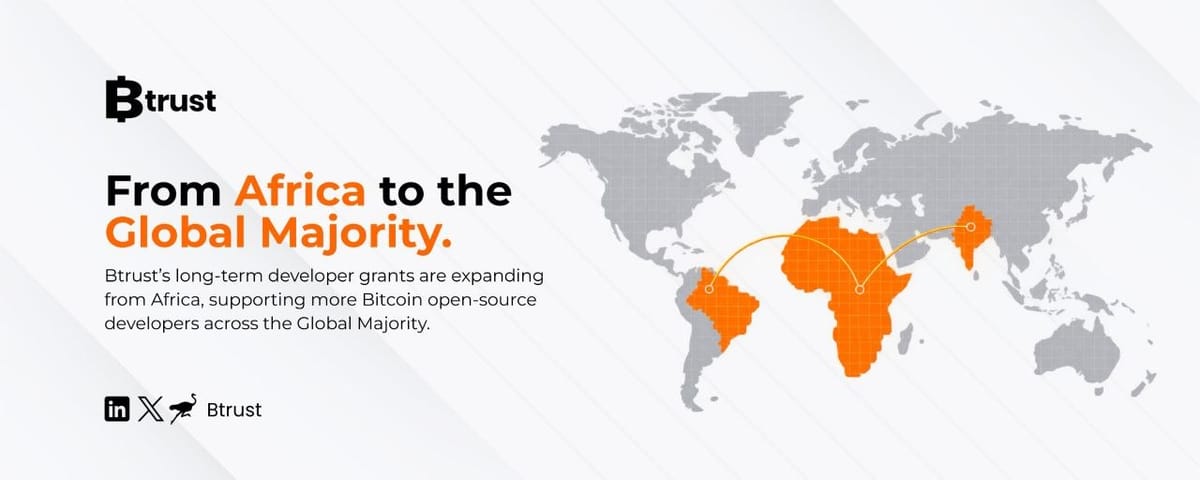
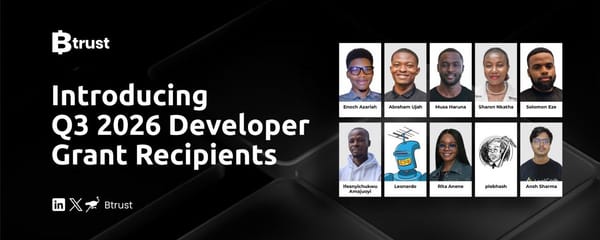
Global Majority, 16th September, 2026 — We’re excited to announce three new recipients of Btrust’s long-term developer grants: plebhash and Leonardo Souza from Brazil, and Ansh Sharma from India.
Their addition marks an important expansion of Btrust’s developer grant program beyond Africa into more regions of the Global Majority. It builds on our mission to decentralize Bitcoin open-source development by ensuring that talented contributors can build sustainable, long-term careers from wherever they live.
This expansion is being carried out in collaboration with Vinteum in Brazil and Bitshala in India; two independent organizations that have played important roles in supporting the recipients’ development and connecting them to their local Bitcoin communities.
Leonardo, plebhash, and Ansh are now Btrust grantees through the Btrust long-term grant program, with their grants funded directly by Btrust for the applicable grant period. They will also remain active members of the Vinteum and Bitshala communities, where they can continue collaborating with peers, participating in technical discussions, mentoring contributors, and receiving community support.
This collaborative approach allows each organization to contribute through distinct and complementary roles. Btrust provides and administers the long-term grant funding, while Vinteum and Bitshala continue to provide the community relationships and local support that have helped these developers grow.
Together, the three developers will contribute to important areas of Bitcoin open source, including decentralized mining protocols, wallet development infrastructure, and peer-to-peer mining pool technology.
Growing Bitcoin Development Across the Global Majority
Btrust was created to help decentralize Bitcoin open-source development, with an initial focus on supporting developers in Africa. Since then, we have funded contributors working on Bitcoin Core, wallets, Lightning, privacy tools, cryptographic libraries, developer infrastructure, and user-facing applications.
Africa remains central to our mission and long-term work. At the same time, decentralizing Bitcoin development requires supporting contributors across the broader Global Majority, including regions that have strong technical talent but remain underrepresented in the development and maintenance of critical Bitcoin infrastructure.
Our collaboration with Vinteum and Bitshala provides a path to expand this support responsibly. Rather than duplicating programs or replacing the role of local organizations, the collaboration brings together complementary strengths.
Vinteum and Bitshala have built strong local communities, supported emerging contributors, and helped developers establish meaningful open-source track records. Btrust’s LTS program can provide established contributors with direct, long-term funding, mentorship, peer support, and the stability required to take on deeper technical responsibilities.
This model recognizes that funding is only one part of a sustainable open-source career. Contributors also need strong peer networks, technical collaboration, local relationships, and opportunities to support the developers coming after them.
Long-Term Grant Recipients
The Btrust LTS program provides established Bitcoin open-source contributors with sustained funding, mentorship, and peer support. It is designed for developers who have demonstrated a consistent commitment to Bitcoin open source and are ready to take on long-term responsibility for important projects.
plebhash
plebhash is a software engineer and Bitcoin open-source contributor based in Brazil. He has a background in electronics and computer engineering, embedded systems, systems integration, and Rust development.
For the past two and a half years, he has worked as a core maintainer of the Stratum V2 Reference Implementation, contributing to infrastructure designed to make Bitcoin mining more open and decentralized.
Stratum is the protocol miners use to communicate with mining pools. The original version places significant control in the hands of pool operators, including influence over the transactions included in block templates. Stratum V2 modernizes this communication and introduces features that can give individual miners greater control, improve efficiency, and strengthen the decentralization of Bitcoin mining.
The Stratum V2 Reference Implementation provides open-source software that developers, miners, and pool operators can use to implement and test the protocol.
plebhash has been supported by Vinteum while contributing to this work and applied to Btrust’s LTS program with Vinteum’s encouragement. With the Btrust LTS grant, he will continue working full-time on Stratum V2. His work will focus on strengthening the reference implementation and advancing infrastructure that can reduce centralizing pressures in Bitcoin mining.
His combination of embedded-systems experience, Rust expertise, and long-term involvement in Stratum V2 gives him a strong foundation for contributing to one of Bitcoin’s most important mining decentralization efforts.
Leonardo Souza
Leonardo Souza is a software engineer and Bitcoin open-source maintainer based in Brazil. He has more than five years of professional software engineering experience and approximately four years of experience contributing to Bitcoin open source.
His work focuses on the Bitcoin Dev Kit (BDK), and the wider Rust Bitcoin ecosystem. BDK is a collection of libraries that helps developers build bitcoin wallets. It provides reusable components for tasks such as tracking wallet transactions, synchronizing with the Bitcoin network, constructing transactions, managing wallet state, and signing. By maintaining these shared components, BDK allows wallet teams to build on well-tested open-source infrastructure instead of implementing complex wallet functionality from scratch.
Leonardo is a BDK maintainer and leads the maintenance of several projects, including bdk_esplora, rust-esplora-client and rust-electrum-client. He is also a secondary maintainer of bdk_wallet, bdk_core, bdk_chain, bdk_electrum and electrum_streaming_client.
These libraries help wallets retrieve blockchain data, track transactions, and interact with services such as Esplora and Electrum. As a maintainer, Leonardo reviews contributions, responds to issues, supports users and new contributors, manages releases, and helps guide the projects’ technical direction.
His previous work includes adding Tor support across BDK’s Esplora and Electrum clients, contributing to Fedimint, and leading a significant refactor of how bdk_chain determines the canonical blockchain state.
With the Btrust LTS grant, Leonardo will continue his ongoing maintenance work while focusing on several longer-term priorities.
He plans to complete the bdk_chain canonicalization refactor and explore caching improvements that can reduce unnecessary computation. He will also strengthen BDK’s testing through structure-aware fuzzing, mutation testing, and potential integration with BitcoinFuzz.
Another area of focus will be exploring new ways for BDK wallets to interact with Bitcoin Core. This includes research and prototypes involving libbitcoinkernel, which exposes parts of Bitcoin Core’s validation logic as a reusable library, and Bitcoin Core’s multiprocess IPC interface.
Leonardo also plans to research whether bdk_chain could evolve toward a UTXO-based model that may better support use cases involving protocols such as Ark and Lightning.
Beyond maintaining code, Leonardo supports the growth of other developers. He has mentored contributors in the BDK ecosystem, leads bitcoinkernel study sessions in the Vinteum community, and holds office hours for developers and users. He also gives BDK talks and workshops at BitDevs meetups and Bitcoin conferences in Brazil.
Ansh Sharma
Ansh Sharma is a software engineer and Bitcoin open-source contributor based in India. He recently completed a bachelor’s degree in computer science at Panjab University and has experience across Rust, C++, JavaScript, TypeScript, Python, embedded programming, robotics, and distributed systems.
For the past year and a half, he has focused primarily on Bitcoin development in Rust. His main project is Braidpool, a peer-to-peer Bitcoin mining pool protocol designed to reduce reliance on centralized pool operators.
Traditional mining pools help individual miners earn more predictable payouts by combining their work. However, this model can place significant control in the hands of pool operators. Braidpool explores a decentralized alternative in which miners coordinate directly rather than depending on a central operator to manage block construction and payouts.
Ansh began contributing to Braidpool through Summer of Bitcoin in 2025 and continued contributing after the program ended. He later received fellowship and starter-grant support from Bitshala, enabling him to work on the project full-time and deepen his involvement in India’s Bitcoin developer community.
His contributions span several parts of Braidpool’s architecture, including consensus algorithms, networking, coinbase construction, payouts, template retrieval through IPC, committed mempools, and a scalable Stratum server implementation. He has also tested parts of his work with Bitaxe devices and CPU miners.
Alongside implementation, Ansh has participated in design discussions and research related to difficulty adjustment, decentralized pool architecture, cryptographic signing, and payout mechanisms. This has included studying technologies and protocols such as FROST, Schnorr signatures, MuSig2, BitVM, the Noise Protocol Framework, and existing peer-to-peer mining systems.
With the Btrust LTS grant, Ansh will continue working full-time on Braidpool. His primary goal will be to make the protocol and its implementation more robust, reliable, and practical as a decentralized mining pool.
Building on the Work of Local Bitcoin Organizations
Vinteum and Bitshala have helped create pathways for developers in Brazil and India to learn, contribute, and build open-source careers.
Their role in the recipients’ journeys does not end with the start of a Btrust grant. plebhash, Leonardo, and Ansh can continue participating in the communities, technical discussions, mentorship relationships, and collaborative activities that have supported their growth.
This collaborative model helps preserve the independence and identity of each organization:
- Btrust provides long-term grant funding, mentorship, peer support, and program administration through its LTS program.
- Vinteum and Bitshala remain independent organizations supporting Bitcoin open-source development and developer community in Brazil and India respectively.
By coordinating rather than duplicating support, the organizations can help contributors gain financial stability without losing the local communities and relationships that are essential to their work.
A Broader Global Majority Contributor Network
The addition of plebhash, Leonardo, and Ansh is an important step in Btrust’s growth, but it is also part of a larger goal.
Bitcoin is a global monetary network, and the people building and maintaining its open-source infrastructure should reflect that global reach. Contributors in the Global Majority bring different technical experiences, local contexts, priorities, and perspectives to Bitcoin development.
Supporting these contributors is not only about geographic representation. It can make Bitcoin development more resilient by distributing knowledge and maintenance responsibility across more people, organizations, and regions.
These grants also demonstrate that developers do not need to leave their local ecosystems to receive international support. plebhash and Leonardo can remain connected to the Brazilian developer community around Vinteum, while Ansh can remain connected to Bitshala’s community in India. Through Btrust’s LTS program, they will also join a wider peer network of Bitcoin contributors from across the Global Majority.
This creates opportunities for knowledge to flow in both directions. Grantees can learn from experienced maintainers and peers across the Btrust network while bringing that knowledge back into their local communities. They can also mentor emerging contributors, strengthen regional technical communities, and help more developers find pathways into Bitcoin open source.
Applications for Btrust Developer Grants
Btrust developer grant applications are open all year round, with new recipients announced quarterly.
The LTS program is intended for established Bitcoin open-source contributors who have demonstrated consistent technical progress and are prepared to take on long-term responsibilities within important projects.
If you are already contributing to Bitcoin open-source software, or are ready to begin contributing full-time, we encourage you to learn more about Btrust’s developer grants and other support opportunities on our website.
We also welcome opportunities to work with independent organizations and developer communities across the Global Majority. Collaborative relationships like those with Vinteum and Bitshala can help contributors access long-term support while remaining rooted in the communities that have helped them grow.
About Vinteum
Vinteum is a Bitcoin research and development center in Brazil. It creates pathways for developers and researchers to contribute to Bitcoin’s open-source ecosystem by providing education, mentorship, funding, and opportunities for collaboration.
Through meetups, seminars, in-person programs, residencies, fellowships, and grants, Vinteum supports contributors throughout their journey, from their first engagement with Bitcoin development to sustained open-source work. Its efforts focus on enabling contributions to Bitcoin Core, the Lightning Network, and other critical infrastructure that helps keep Bitcoin secure, decentralized, and usable.
About Bitshala
Bitshala is a grassroots education initiative led by Indian Bitcoiners. It works to strengthen the Bitcoin ecosystem by nurturing and supporting developers who contribute to Bitcoin free and open-source software.
Through open-source educational resources, structured learning programs, mentorship, and community support, Bitshala helps aspiring developers build the multidisciplinary knowledge required to contribute to Bitcoin.
About Btrust
Btrust is a non-profit organization with a mission to decentralize the development of Bitcoin open-source software. We focus on supporting developer talent from the Global Majority and strengthening the free and open-source Bitcoin ecosystem.
Through grants, education, mentorship, and community support, Btrust helps developers contribute to the tools, infrastructure, and applications that make bitcoin more resilient, accessible, and decentralized.