Builders Beyond the Program: What Btrust Builders Alumni Are Working On Today (Part 2)
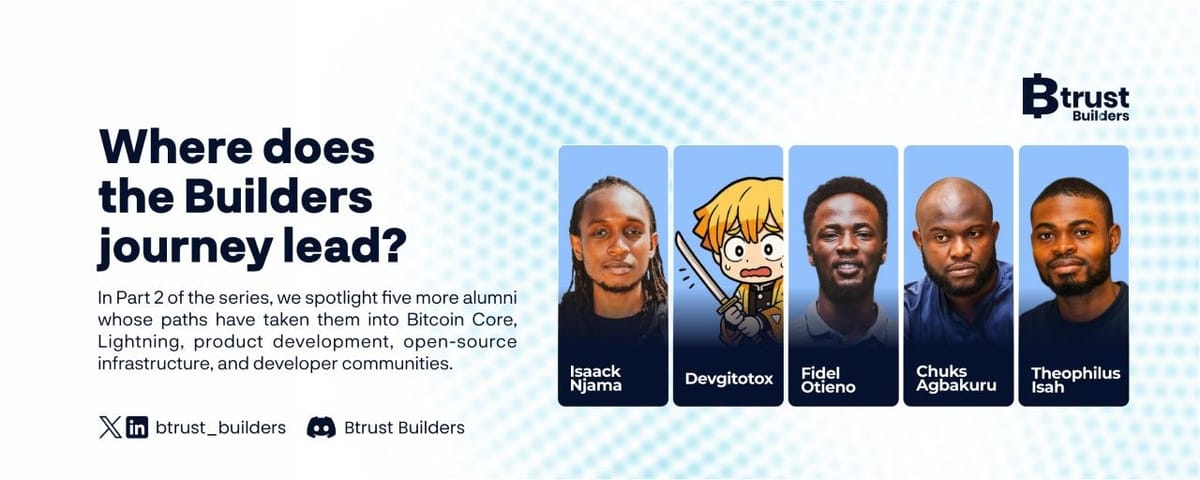
The journey through Btrust Builders can lead in many directions. Alumni have gone on to work on Bitcoin infrastructure, build products, contribute to open-source projects, teach other developers, and create communities where more people can find their way into Bitcoin development.
In part one, we looked at five alumni contributing to Bitcoin Core, Lightning infrastructure, wallet tooling, and merchant payments. In this edition, the work takes us into different parts of the ecosystem, from building products and open-source infrastructure to teaching developers and growing local communities.
Isaack Njama
Isaack's work sits across two parts of the Bitcoin ecosystem: building software and helping other developers understand it.
A 2024 Btrust Builders fellow, Isaack is a developer at Minmo, where he works with TypeScript and Rust. Minmo builds tools that help communities integrate bitcoin into their financial activities, and he is part of the engineering team working on that infrastructure.
He is also a co-lead of BitDevs Nairobi, one of the developer communities creating regular spaces for technical conversations around Bitcoin in Kenya. At the Bitcoin Nairobi Conference earlier this year, he joined a panel on the state of Bitcoin in Africa alongside other builders working across the region.
His involvement extends into hands-on education as well. At the 2025 Btrust Developer Day, Isaack led a practical session on building with the Minmo API, taking participants through the process of creating a Bitcoin off-ramp connected to Minmo's agent network. The session covered user setup, swaps, escrow, settlement, and dispute tracking.
Isaack is also part of the Btrust Builders chaperones, supporting learners through their open-source journey and helping push Bitcoin knowledge forward within the ecosystem. Through this role, he contributes not just as a builder, but as someone helping others develop the skills and confidence to contribute themselves.
He is also building SatStreak, a bitcoin-native project, while continuing to contribute to the developer community around him. His work stretches from writing software to making technical knowledge easier for other people to access, and both have become part of his contribution to Bitcoin's growing developer ecosystem in Africa.
Theophilus Isah
Theo has spent the last few years working on one of bitcoin's most practical applications: moving money across borders.
A member of the Genesis cohort in 2022, Theophilus is the co-founder of Mavapay and a member of the Btrust Builders faculty. He has also led developer workshops and bootcamps across Africa, helping developers build their understanding of Bitcoin and open-source technology.
Mavapay has grown considerably since its launch. The platform currently supports cross-border transfers involving markets including Nigeria, Kenya and South Africa. Users can send money to South African bank accounts from Nigeria, receive Naira through Lightning from services such as Strike and Cash App, and move between bitcoin and local currencies through the app.
The company has also continued building infrastructure for businesses. Its BTCPay Server checkout plugin allows Nigerian customers to pay merchants with bitcoin, Lightning, or Naira, while the merchant receives bitcoin.
Theophilus remains involved in developer education alongside the product work, giving him a role in both building bitcoin-based financial infrastructure and helping other developers understand what they can build with it.
Fidel Otieno
Fidel is working on two problems that sit at different ends of the bitcoin experience: getting people into bitcoin and helping developers find meaningful ways to contribute to it.
A 2025 Btrust Builders alumnus, Fidel is the co-founder of Bitika, a service that lets users buy bitcoin with Kenyan shillings and receive it directly into a Lightning wallet. The product connects bitcoin to a payment method many Kenyans already use, including M-Pesa and Airtel Money. At bitcoin++ Nairobi in June, he led a live walkthrough that took participants through a real Bitcoin block, an on-chain transaction, a Lightning payment, and buying bitcoin with mobile money into self-custody.
Fidel also recently worked with Chris Oketch on Robin, an AI-powered guide for aspiring Bitcoin open-source contributors. The project was built during bitcoin++ Nairobi hackathon and placed second overall, earning 1.5 million satoshis.
Robin helps developers understand where their existing skills could be useful before they begin contributing. It asks about their background and interests, then directs them towards projects and areas where they are more likely to make a meaningful contribution.
The two projects give Fidel different ways to work on accessibility. Bitika reduces the friction involved in getting bitcoin into a user's hands. Robin helps reduce the uncertainty that can make open-source contribution difficult for a developer who is just getting started.
devgitotox
devgitotox's work has taken her into some of the deeper layers of Bitcoin development. A 2025 Btrust Builders alumna, she has participated in several of the program's technical pathways, including BOSS, Bitcoin CLI, Rust for Bitcoiners, and the 2025 Open Source Bootcamp.
Funded by HRF, she contributes to Bitcoin Core, where her current work includes reviewing the custom HTTP server implementation, and testing changes within the wallet subsystem.
Her work also extends into other open-source projects. She contributes to Cashu's Nutshell wallet and mint implementation and works with Warnet, adding experience across different parts of Bitcoin's technical stack.
These projects require careful review, testing, and a strong understanding of how software behaves under different conditions. In Bitcoin Core especially, reviewing changes to foundational components means working through code that other developers and applications will eventually depend on.
devgitotox's progression through several Btrust Builders technical programs into active open-source contributions is also part of a longer development path. The courses gave her opportunities to build technical knowledge across Bitcoin's tooling and programming environments, and that work now continues through direct participation in open-source projects.
Chuks Agbakuru
Chuks moved from learning about Bitcoin development to working directly on the infrastructure behind the Lightning Network.
A 2025 BOSS alumnus and current Btrust grantee, Chuks is now a full-time contributor to the Lightning Dev Kit ecosystem. His work has included contributions to LDK-Node, including support for human-readable names through BIP353, as well as infrastructure improvements and code reviews. His current focus is splice batching in LDK.
Splicing allows a Lightning channel to be modified without having to close and reopen it. Chuks is working on ways to batch multiple splice operations together, reducing the number of on-chain transactions required, and making the process more efficient. His grant work covers research, implementation in Rust, and integration into LDK‑Node APIs.
Alongside his open-source work, Chuks is an active member of BitDevs Lagos and has continued to mentor developers who are interested in contributing to Bitcoin projects.
His path through BOSS, a starter grant, and now long-term support reflects the kind of progression that can happen when a developer finds a project worth staying with. Today, his contributions sit inside infrastructure that other developers can build on as Lightning continues to evolve.
The Work Continues
The five alumni in this edition are working at different points across the Bitcoin ecosystem. Their stories also show the range of work that can follow a Btrust Builders experience. A developer can move from a technical program into a product team, an open-source project, a research problem, a developer community, or several of these at once.
The program is one part of that journey. What comes after it is shaped by the projects each developer chooses to take seriously, the communities they contribute to, and the problems they decide are worth solving. These five are still building, and we'll keep following where the work takes them.
Ready to Start Building?
If you want to follow a path like the builders featured in the two articles, there’s a place to start. Join the Btrust Builders community to explore our learning pathways, connect with other developers, and discover opportunities to contribute to the Bitcoin ecosystem.
Whether you’re just getting started or looking to take your skills further, you can find pathways, programs, and opportunities to help you keep building.