Announcing Q2, 2026 Btrust Developer Grant Recipients
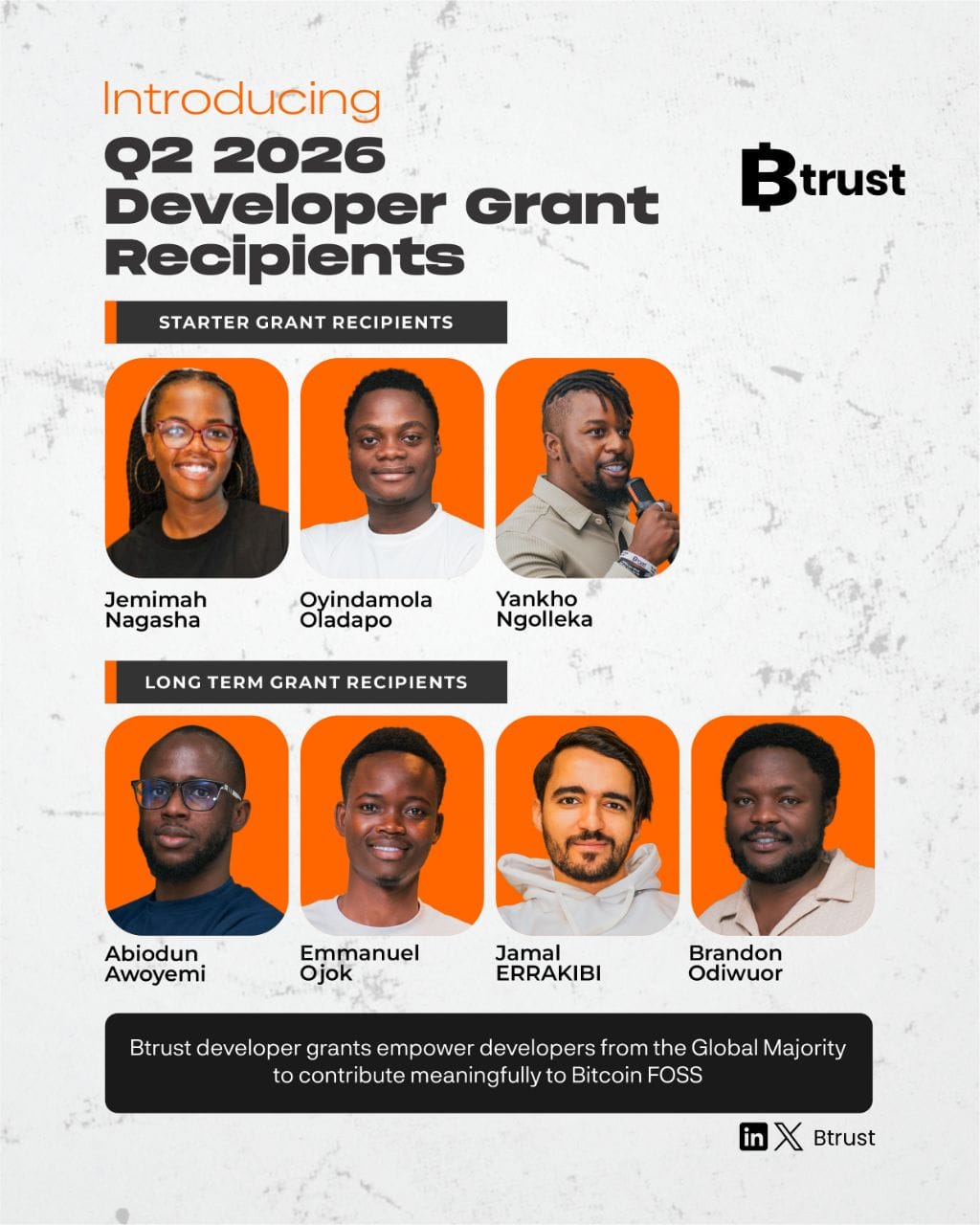
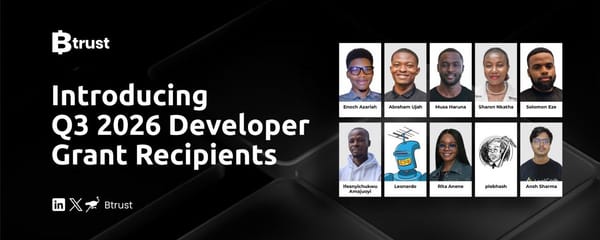
Africa, July 13, 2026 - We’re excited to announce the Q2 2026 Btrust developer grant recipients. Last quarter, seven Bitcoin open-source developers were awarded grants, including three starter grant recipients and four long-term open-source cohort members.
This cohort continues our mission to decentralize Bitcoin open-source development by supporting talented contributors from the Global Majority. Their work spans wallet infrastructure, Bitcoin Core testing, developer tools, privacy-preserving payments, peer-to-peer exchange infrastructure, cryptography, and user-facing bitcoin applications.
The quarter also marked an important first for us: for the first time, we supported a grantee working on peer-to-peer exchange infrastructure. This expands the scope of our grant program into tools that can help people access Bitcoin in places where traditional onramps are limited or unavailable.
Another defining theme of this cohort is community. All but one of the recipients have been through the Btrust Builders program, showing how structured learning, mentorship, and hands-on open-source experience can help developers grow into long-term Bitcoin contributors. Many of the recipients also help organize or participate in local BitDevs communities across Africa, including in Lagos, Kampala, Kaduna, Malawi, and Nairobi.
Starter Grants
The Btrust starter grant supports software engineers who are ready to contribute full-time to open-source Bitcoin development. It gives recipients the time, mentorship, and financial support they need to explore a focused area of Bitcoin open source, make meaningful contributions, and grow into long-term contributors.
Starter Grant Recipients
Jemimah Nagasha
Nagasha is a software engineer based in Kampala, Uganda. She has experience building web and mobile applications and brings a strong systems-oriented approach from her background in civil engineering and software development.
Her Bitcoin development journey began through the Btrust Builders Fellowship, where she gained hands-on experience with Bitcoin internals, Lightning Network tooling, and open-source collaboration.
Since then, Nagasha has been contributing to Polar, an open-source desktop application used by Bitcoin and Lightning developers to create local testing environments. It helps developers safely test Bitcoin and Lightning applications on their own computers before building for real users.
Her work so far has focused on making Polar easier and more reliable to use. She has helped add the ability to rename nodes, improved the manual block-mining workflow, contributed to Tor support for nodes, and participated in pull request reviews and issue discussions.
With the starter grant, Nagasha will work full-time on improving Polar’s usability, reliability, and developer experience. Her planned work includes adding better support for Core Lightning on Windows, improving wallet locking and unlocking workflows, adding seed phrase and backup management tools, and fixing bugs that affect developer testing.
She also helps grow the local Bitcoin developer community by organizing BitDevs Kampala, creating a space for developers in Uganda to learn, discuss, and contribute to Bitcoin.
Oyindamola Oladapo
Oyindamola is a software engineer based in Kaduna, Nigeria, with experience building and maintaining reliable software systems. He was part of the inaugural Btrust Builders’ Rust for Bitcoiners pathway, where he deepened his understanding of Rust and Bitcoin development and graduated as the top student.
He has since become an active contributor to privacy-focused Bitcoin tools, especially Rust-Payjoin and related Payjoin projects.
Payjoin is a privacy technique that helps make bitcoin transactions harder to analyze from the outside. Instead of a transaction clearly looking like it came from one person paying another, Payjoin allows both sides to collaborate in a way that makes ownership patterns less obvious. This helps protect user privacy without changing Bitcoin’s base protocol.
Oyindamola’s contributions have included privacy-safe logging, code audits, spendable coin checks, documentation improvements, and work on simulations for multiparty Payjoin. Multiparty Payjoin is an extension of this idea, allowing more than two participants to collaborate in a transaction and strengthen privacy further.
With the starter grant, Oyindamola will focus on advancing multiparty Payjoin research and implementation. His work will include helping refine the protocol design, improving simulations, contributing to the Payjoin Development Kit, writing tests, improving documentation, and working closely with maintainers to make the system safer and easier for wallet developers to use.
Beyond code, Oyindamola co-hosts BitDevs Kaduna and has supported local bitcoin education efforts, including mentoring and judging at the Hack4Freedom Hackathon in Kaduna.
Yankho Ngolleka
Yankho is a Bitcoin developer and community builder based in Lilongwe, Malawi. His technical journey began at Btrust Builders, where he received the Top Student Award among an international cohort of Bitcoin developers.
He has experience with Bitcoin Core tools, the Nostr protocol, and Lightning Network concepts such as hold invoices and payment retries.
Yankho contributes to MostroP2P, a peer-to-peer bitcoin exchange system built on Nostr and the Lightning Network. Mostro helps people buy and sell bitcoin directly with each other, without relying on a centralized exchange. This kind of infrastructure can be especially important in countries and communities where formal bitcoin onramps are limited, unreliable, or unavailable.
This makes Yankho’s grant especially notable as he is Btrust’s first grantee focused on peer-to-peer exchange infrastructure.
His contributions to the Mostro ecosystem include test coverage, error handling improvements, user experience improvements in the command-line tool, website fixes, code reviews, and work related to the reliability of the Mostro daemon.
With the starter grant, Yankho will work full-time on improving MostroP2P’s reliability and usability. His planned work includes strengthening error handling, expanding mutation testing, investigating bugs that could affect real trades, improving the Mostro command-line experience, and running a live Mostro node in Malawi.
He also plans to grow the Malawian Bitcoin developer community through BitDevs Malawi, using the live Mostro node as a practical example of how open-source Bitcoin infrastructure can serve local needs.
Long-Term Grants
The Btrust Open-Source Cohort provides long-term support to established Bitcoin open-source contributors. Members receive funding, mentorship, and peer support so they can continue working on important Bitcoin projects over a longer period.
These grants are designed to help contributors build deep expertise, maintain critical open-source software, and make lasting contributions to the Bitcoin ecosystem.
Long-Term Grant Recipients
Abiodun Awoyemi
Abiodun is a software engineer and Bitcoin open-source contributor based in Lagos, Nigeria. His work focuses on wallet infrastructure in the Bitcoin Dev Kit ecosystem.
Bitcoin Dev Kit (BDK) is a set of tools that helps developers build bitcoin wallets. Instead of every wallet developer having to solve the same difficult problems from scratch, BDK provides reusable building blocks for transaction construction, wallet state, signing, and other core wallet features.
Abiodun is a secondary maintainer of bdk-tx, a transaction-building library in the BDK ecosystem. His role includes reviewing pull requests, guiding technical discussions, and helping maintain code quality.
His contributions have covered many areas that directly affect wallet safety and reliability, including fee calculation fixes, anti-fee-sniping support, Payjoin examples, CPFP fee-bumping support, locktime handling, BIP353 payment support reviews, PSBT creation, BIP322 message signing, and continuous integration improvements.
With the long-term grant, Abiodun will continue strengthening BDK and BDK-TX. His work will focus on making Bitcoin transaction construction safer, more predictable, and easier for developers to use. Planned areas include better fee handling, clearer errors, improved transaction ordering, policy-aware transaction building, timelock correctness, and foreign function interface support so that BDK-TX can be used more easily outside the Rust ecosystem.
Abiodun also contributes to local developer education as a co-organizer of BitDevs Lagos, helping create space for technical Bitcoin discussion and contributor growth in Nigeria.
Emmanuel Ojok
Ojok is a software engineer based in Kampala, Uganda. He has experience building web and mobile applications using JavaScript, TypeScript, React, React Native, and Node.js. He is also
His Bitcoin development journey began through Btrust Builders programs, including the BOSS cohort, Learn Bitcoin from the Command Line, and the Open Source Bootcamp. Over the past grant period, he has worked full-time on BlueWallet, a self-custodial bitcoin and lightning wallet for iOS and Android.
BlueWallet is used by people around the world to hold and manage their own bitcoin. Work on a wallet like BlueWallet directly affects user safety, privacy, reliability, and ease of use.
During his previous grant period, Ojok contributed to several important improvements. He helped migrate parts of the codebase from Buffer to Uint8Array, worked on converting JavaScript code to TypeScript, contributed to Silent Payments-related code, improved user interface screens, reviewed wallet features, and worked on removing or replacing dependencies that are not ideal for an open-source wallet.
He has also been working on reproducible builds. Reproducible builds help users and developers verify that the app they install matches the open-source code. This strengthens trust and aligns with bitcoin’s culture of verification.
With the long-term grant, Ojok will continue improving BlueWallet. His planned work includes Android 16KB page size compliance, finalizing reproducible builds, modernizing Gradle, improving interoperability with hardware and external wallets, expanding end-to-end test coverage, and exploring a Taproot CLTV savings wallet feature.
His work will help make BlueWallet more reliable, easier to maintain, and more trustworthy for users who depend on self-custodial bitcoin tools.
Ojok also contributes to local Bitcoin developer education as a co-organizer of BitDevs Kampala, helping create a space for developers in Uganda to learn, discuss Bitcoin technical topics, and connect with open-source contribution opportunities.
Jamal ERRAKIBI
Jamal is a software engineer from Morocco with several years of professional engineering experience and more than two years of active Bitcoin open-source contribution. He is also active in bitcoin education and has built learning resources such as BTCillustrated and an interactive SHA-256 explainer.
Jamal’s work focuses on the lower-level libraries that many Bitcoin projects depend on. These libraries are not always visible to everyday users, but they are part of the foundation that makes Bitcoin software secure, fast, and reliable.
During his previous grant period, Jamal made significant contributions across the rust-bitcoin ecosystem. He opened and reviewed many pull requests and issues, worked on the hashes crate, added SHA256 ARM hardware acceleration, improved benchmarking, added test vectors, helped fix hashing-related issues, and contributed to the consensus encoding crate.
Some of this work improves performance. Some improve safety. Some reduce the risk of bugs in code that many bitcoin applications rely on.
With the long-term grant, Jamal will continue working on performance and cryptographic foundations in the Rust Bitcoin ecosystem. His planned work includes optimizing double-SHA256, adding SIMD implementations for different processor architectures, benchmarking Bitcoin-related Rust crates, deepening work on rust-secp256k1, reviewing Silent Payments support, and writing educational material for the Btrust blog.
He also plans to explore quantum-computing-related topics relevant to Bitcoin and continue mentoring Btrust Builders students and starter grantees.
Brandon Odiwuor
Brandon is a Bitcoin Core contributor based in Kenya whose work focuses on build systems, testing, continuous integration, functional tests, documentation, RPC improvements, GUI work, and code review.
During his previous grant period, he contributed across many parts of Bitcoin Core. His work included build-system improvements, functional test enhancements, Signet configuration support, RPC coverage fixes, offline signing documentation, GUI improvements, and extensive review of CI and build-related pull requests.
Bitcoin Core is the reference implementation of the Bitcoin protocol. Because of this, its testing and build systems are extremely important. When developers make changes to Bitcoin Core, continuous integration systems help check that those changes do not break important functionality.
Brandon’s long-term project focuses on improving Bitcoin Core’s CI pipeline using CTest and CDash. In simple terms, CTest can help standardize how tests are run, while CDash can provide clearer dashboards for tracking test results, failures, and trends over time.
This work aims to make Bitcoin Core testing easier to understand, easier to debug, and more consistent across different operating systems and environments.
With the long-term grant, Brandon will prototype CTest integration for Bitcoin Core tests, help set up and improve a CDash dashboard, update CI workflows, support sanitizer and coverage reporting, review CI and build-related changes, and continue mentoring new contributors.
He also helps grow the Bitcoin developer community through BitDevs Nairobi, where he leads Socratic seminars and supports technical discussions around Bitcoin Core development.
Btrust Builders Alumni
A major theme of the quarter’s cohort is the role of Btrust Builders in helping developers move from learning to meaningful open-source contribution.
All but one of the recipients in this cohort have participated in Btrust Builders or related Btrust learning pathways. These programs provide structured education, technical mentorship, and practical open-source experience. They help developers understand Bitcoin deeply, build confidence, and begin contributing to real projects used by the wider ecosystem.
This progression from Builders participants to funded grantees reflects Btrust’s long-term approach to identify talented developers, support their learning, provide mentorship, and help them build sustainable careers in Bitcoin open source.
Btrust Builders pathway applications are open all year round. If you are interested in learning Bitcoin development and joining a future cohort, we encourage you to apply.
You can also check the program calendar to see when the 2026 Btrust Builders pathways are scheduled next.
Strengthening BitDevs Communities Across Africa
This cohort also shows the importance of local developer communities. Several recipients organize or support BitDevs meetups in their cities, including Lagos, Kampala, Kaduna, Malawi, and Nairobi. These communities create spaces where developers can discuss Bitcoin technical topics, review new developments, learn from each other, and find pathways into open-source contributions.
Btrust supports the largest network of BitDevs communities in Africa, helping strengthen local Bitcoin developer ecosystems across the continent.
The work of these grantees is not limited to code. By organizing meetups, mentoring newer contributors, and creating learning opportunities, they are helping build the next generation of Bitcoin open-source developers.
If there is a BitDevs community near you, we encourage you to participate, attend a meetup, and connect with other developers learning and contributing to Bitcoin open source. If there isn’t one in your city, you can check out the BitDevs Playbook to learn how to build a sustainable community, and apply for Btrust support to help get it started.
Applications for Btrust Developer Grants
Btrust developer grant applications are open all year round, with new recipients announced quarterly.
If you are already contributing to Bitcoin open-source software, or you are ready to begin contributing full-time, we encourage you to learn more and apply.
You can learn more about Btrust developer grants and explore other Btrust grant opportunities on our website.
About Btrust
Btrust is a non-profit organization with a mission to decentralize the development of Bitcoin open-source software. We focus on supporting developer talent from the Global Majority and strengthening the free and open-source Bitcoin ecosystem.
Through grants, education, mentorship, and community support, Btrust helps developers contribute to the tools, infrastructure, and applications that make bitcoin more resilient, accessible, and decentralized.